




Uganda’s Ministry of Finance, Planning and Economic Development has called for increased domestic financing of healthcare to reduce dependence on donor funding and strengthen the country’s health system.
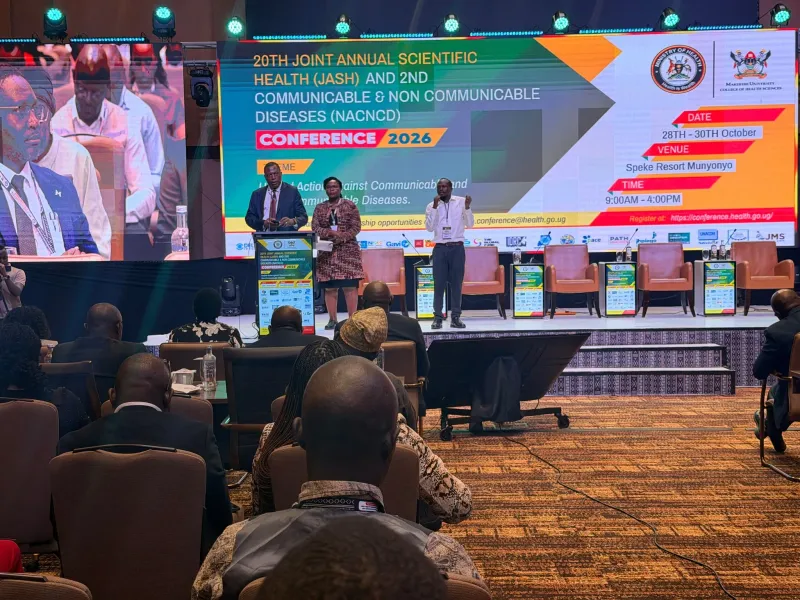
The call was made by Mr Joseph Enyimu, who delivered a keynote address on behalf of the Permanent Secretary and Secretary to the Treasury during the 20th Joint Annual Scientific Health Conference (JASH) and the 2nd Annual Communicable and Non-Communicable Diseases Conference 2026 at Speke Resort Munyonyo.
Held under the theme “Unified Action Against Communicable and Non-Communicable Diseases,” the conference brings together policymakers, researchers, health professionals, academics and development partners to discuss evidence-based approaches to addressing Uganda’s disease burden.
Enyimu said Uganda needs to strengthen its ability to mobilise domestic resources to finance essential health services and respond effectively to both communicable and non-communicable diseases. He emphasised that sustainable healthcare financing should align with the country’s long-term economic transformation ambitions.
He noted that development assistance has played an important role in supporting progress against HIV/AIDS, malaria, tuberculosis and other infectious diseases. However, continued reliance on external funding exposes the health sector to changing donor priorities and potential financing disruptions.
He called for increased domestic revenue mobilisation to ensure reliable funding for essential medicines, healthcare workers and primary healthcare services.
Enyimu outlined five key areas for reforming health financing: increasing domestic revenue, expanding health insurance coverage, mobilising domestic savings and private investment, adopting sustainable borrowing and public-private partnerships, and improving the efficiency of public expenditure.
The Ministry linked these priorities to Uganda’s Ten-Fold Growth Strategy, which aims to expand the economy to USD 500 billion by 2040. Enyimu emphasised that achieving this target requires a healthy and skilled workforce supported by accessible and reliable healthcare services.
The strategy also aims to increase health insurance coverage from approximately one per cent of the population in 2021 to 48 per cent by the 2029/30 financial year. Expanding insurance coverage is expected to form part of broader efforts to improve healthcare financing and access to essential services.
Addressing Uganda’s growing burden of non-communicable diseases, including cancer, diabetes, cardiovascular diseases and kidney conditions, Enyimu called for more integrated healthcare delivery. He said health facilities should increasingly adopt approaches that enable patients to receive care for multiple conditions during a single visit.
He also highlighted the importance of preventive healthcare, workplace screening and fiscal measures designed to discourage harmful health behaviours. These include taxation of tobacco and alcohol, which can help reduce disease risks while generating revenue for public services.
Beyond improving public health, Enyimu identified opportunities for Uganda to develop its healthcare sector into a driver of economic growth. Areas with potential include medical tourism, specialised treatment, pharmaceutical manufacturing, diagnostic services, medical education and digital health.
He observed that expanding access to internationally competitive specialised medical services could help reduce the amount of money Ugandans spend seeking treatment abroad, retain foreign exchange within the country and attract patients from neighbouring countries.
The opportunities identified include specialised cardiac care, oncology, renal and transplant services, orthopaedics, eye care, laboratory services and rehabilitation.
Enyimu stressed that investment in these areas, including through public-private partnerships, must meet international standards while improving access to healthcare for Ugandans. He also underscored the importance of supporting local training, maintaining transparent pricing and ensuring that investment benefits the wider population.
He urged development partners to support national systems and strengthen Uganda’s domestic capacity rather than creating long-term dependence on external assistance. Researchers were also encouraged to provide evidence on the cost-effectiveness of health interventions, their impact on health outcomes and the economic returns of healthcare investments.
Enyimu concluded that sustainable healthcare financing will require domestic revenue, wider health insurance coverage, responsible borrowing, efficient spending and investment in a competitive healthcare industry.
The call reflects the broader challenge facing Uganda as it seeks to maintain essential health services while building a more resilient financing system capable of responding to changing funding conditions and the country’s evolving health needs.






Sunrise reporter
Leave a Comment
Your email address will not be published.