
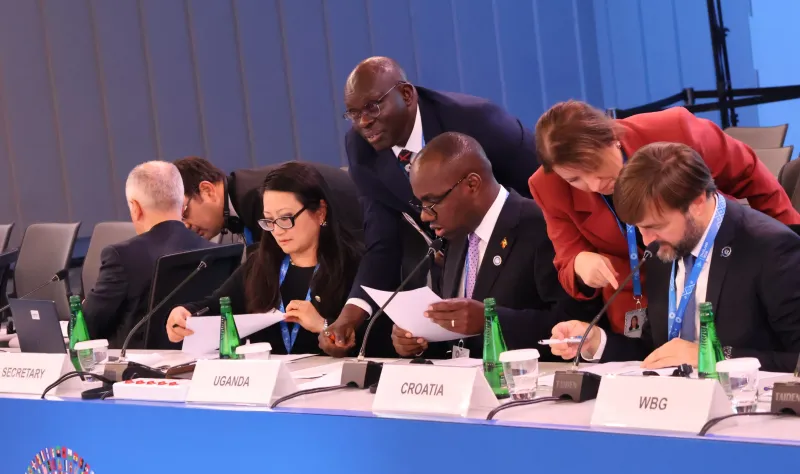




Uganda’s Finance Minister, Henry Musasizi, has called for climate adaptation and resilience investments to be recognised in debt sustainability assessments, saying the approach could expand fiscal space for development, lower borrowing costs and strengthen economies against future shocks.
Musasizi made the call on Wednesday, while chairing the 16th Ministerial Meeting of the Coalition of Finance Ministers for Climate Action in Bangkok, Thailand, on the sidelines of the 2026 World Bank-IMF Annual Meetings.
The Coalition brings together 103 finance ministries to integrate climate considerations into economic and fiscal policymaking.
Musasizi said efforts were progressing to incorporate the economic benefits of climate adaptation and resilience investments into debt sustainability analysis. He noted that Zambia was already replicating the approach, with plans to extend it to other countries.
“For most countries, this is very important because it is intended to increase the fiscal space for investment and reduce the cost of capital, thus allowing the public sector to invest in private sector finance-enabling infrastructure,” Musasizi said.
The proposed approach seeks to ensure that assessments of government debt take greater account of the economic benefits generated by investments that protect communities, infrastructure and national economies from climate-related shocks.
By recognising these benefits, governments could have more room to finance development priorities while maintaining responsible debt management.
Musasizi also stressed the importance of preserving macroeconomic stability and fiscal sustainability while protecting investments that strengthen resilience to future shocks, particularly amid the evolving global energy crisis.
The meeting highlighted the growing importance of integrating climate considerations into mainstream economic and fiscal decision-making.
Tomislav Ćorić, Croatia’s Deputy Prime Minister and Minister of Finance, said the evolution of green budgeting reflected a broader change in how governments allocate public resources and plan for long-term development.
“The evolution of green budgeting reflects a broader shift in how governments make decisions. Climate considerations are increasingly becoming part of mainstream economic and fiscal policymaking, helping us better align public resources with long-term resilience and sustainable growth,” Ćorić said.
His remarks underscored the role of fiscal planning in aligning government expenditure with climate resilience and sustainable economic growth.
World Bank Group Vice President for Planet, Guangzhe Chen, emphasised the need for governments to respond to immediate economic pressures while also preparing for future challenges.
“At this Coalition, one message was clear: our response to today’s shocks must also build resilience for tomorrow,” Chen said.
The World Bank Group reaffirmed its commitment to supporting finance ministries in translating climate ambitions into practical, country-led action aimed at protecting development gains and building resilient economies.
The Coalition continues to support capacity-building in climate adaptation, the green transition and economic resilience. It is also strengthening cooperation with central banks and financial supervisors to help mobilise climate finance.
The discussions reflect growing efforts to integrate climate resilience into public financial management while balancing development needs, borrowing costs and long-term fiscal sustainability.






Sunrise reporter
Leave a Comment
Your email address will not be published.