
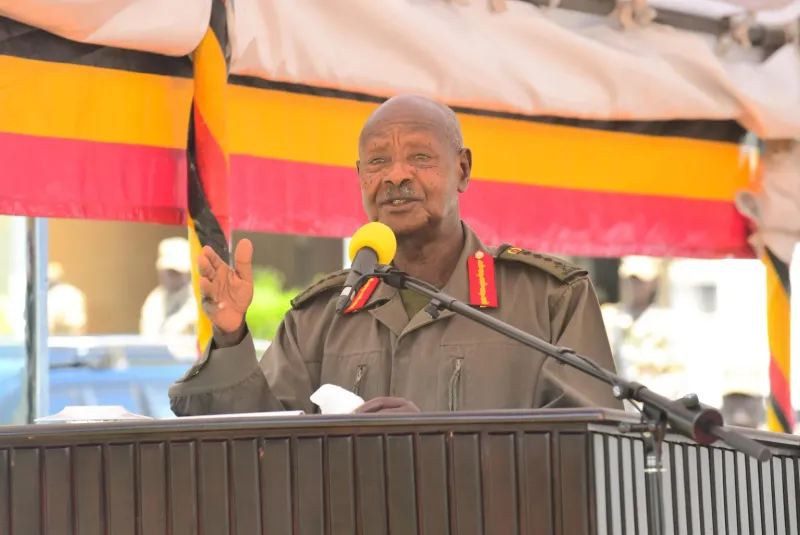

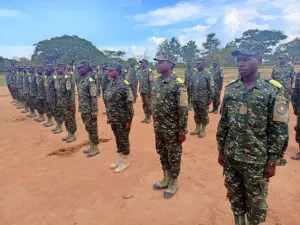
President Yoweri Kaguta Museveni, who is also the Commander-in-Chief of the Uganda Peoples' Defence Forces (UPDF), has called for deeper economic and political integration across Africa, arguing that unity is essential for the continent's prosperity, security and future development.
Speaking during a lecture of opportunity to army officers at the Senior Staff College in Kimaka, Jinja, President Museveni reflected on Africa's historical challenges and the need for strategic leadership to address them.
The President criticized some African kings and chiefs during the colonial era for failing to recognize the dangers posed by colonial expansion, saying their focus on personal interests contributed to the continent's vulnerability.
He told the officers that for the past six decades, the National Resistance Movement (NRM) has consistently emphasized historical missions aimed at transforming Uganda, East Africa and the African continent.
According to Museveni, the first mission is achieving prosperity through economic transformation and regional market integration. He noted that expanding and integrating African markets would create greater opportunities for growth and development.
The President encouraged young people to support regional integration efforts, warning that failure to unite economically could create future challenges for African countries.
On security matters, Museveni argued that Africa's long-term safety and strategic interests require political integration. He said the continent must build the capacity to defend itself across land, air, maritime and space domains if it is to compete effectively on the global stage.
He questioned whether individual countries such as Uganda could independently sustain major strategic projects, including space programs, and said colonial-era borders continue to limit the continent's potential. He maintained that stronger political cooperation within East Africa remains the most practical solution.
Museveni also addressed concerns about land shortages in some African countries, attributing the challenge largely to underdevelopment and the heavy dependence of many citizens on subsistence agriculture. He observed that developed economies employ larger portions of their populations in manufacturing and service industries, reducing pressure on agricultural land.
Commenting on conflicts in the Middle East and their implications for East Africa, the President said Africa possesses sufficient natural resources to withstand many external shocks if those resources are effectively utilized.
He further criticized politics based on tribe, religion and other forms of identity, describing such approaches as a sign of ideological weakness. “The politics of identity is politics of parasites,” he said
The President emphasized the importance of patriotism and Pan-Africanism, saying both are essential for expanding markets and creating opportunities for local products and businesses.
Regarding employment and wealth creation, President Museveni highlighted four sectors that continue to drive economic growth in Uganda: commercial agriculture, manufacturing, services and information and communication technology (ICT).
The Commandant of the Senior Staff College-Kimaka, Brig Gen Michael Kabango, commended President Museveni for what he described as visionary leadership that has contributed to peace, stability and development in Uganda.
Kabango said the current Senior Staff College course, Intake 21-2025/2026, began on July 8, 2025, and is expected to conclude on July 2, 2026.
The course has a total of 52 students, including 38 Ugandans and 14 officers from Burundi, Egypt, Kenya, Malawi, Rwanda, South Africa, South Sudan and Tanzania.


The Sunrise Editor
Leave a Comment
Your email address will not be published.