
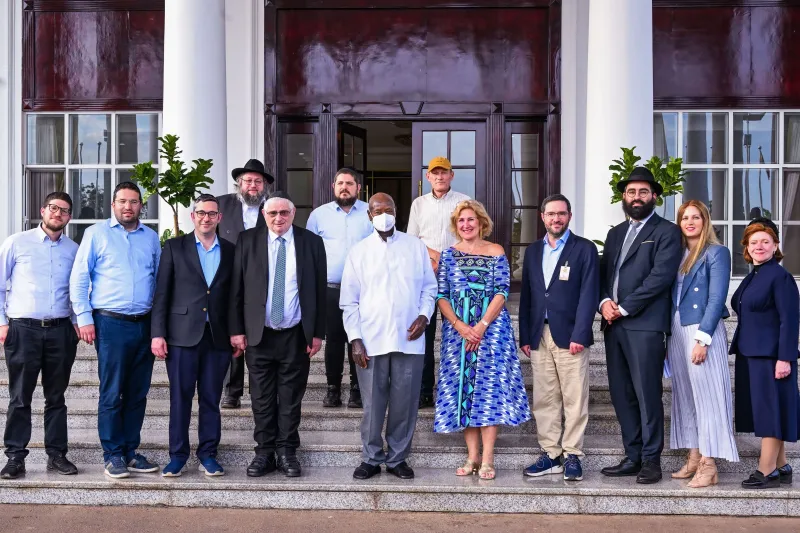

President Yoweri Museveni on Tuesday hosted Gilbert Weill, one of the survivors of the 1976 Entebbe hijacking, together with his family and friends at State House, Entebbe, as they returned to Uganda nearly 50 years after the historic incident.
In a statement shared after the meeting, Museveni reflected on the significance of the 1976 hijacking and the rescue operation that followed.
“I told them that although the hijacking was a tragedy, the rescue operation became a turning point and marked the beginning of the collapse of the Idi Amin regime,” Museveni said.
The President also highlighted Uganda’s transformation since that period, pointing to the peace, stability and progress the country enjoys today. He emphasized the importance of strengthening economic cooperation between Uganda, Israel and Europe, particularly in value addition and agro-industrialisation.
The visit came days after a delegation of Israeli and Belgian former hostages returned to Uganda and toured the old terminal at Entebbe International Airport, where they had been held during the hijacking.
Uganda Peoples’ Defence Forces Acting Director of Defence Public Information, Colonel Chris Magezi, described the hijacking as a terrorist act targeting innocent civilians and said such incidents should never be repeated.
According to Col Magezi, while the event was tragic, the rescue operation became a turning point in relations between Uganda and Israel. He noted that the two countries cooperate in military technical fields, intelligence sharing, agriculture, information technology and efforts to combat terrorism.
“We share a lot with Israel, especially in military technical cooperation, intelligence sharing, and civilian sectors such as agriculture, information technology, and the global fight against terrorism,” Col Magezi said.
He added that Uganda continues to value its partnership with Israel and pledged support for future commemorative visits by former hostages and their families.
Among the visitors was Gilbert Weill, who returned to Uganda accompanied by his two sons, grandchildren and a delegation of more than 30 Jewish and Belgian visitors.
Weill described the journey as deeply personal and an opportunity to honour the memory of his late wife, who passed away a year and a half ago, as well as those who lost their lives during the operation.
“This is a journey of healing and remembrance,” he said.
He also expressed appreciation for Uganda’s hospitality and said he was looking forward to once again tasting Uganda’s famous yellow bananas, which he remembered from his time in Entebbe in 1976.
Uganda’s Ambassador to Belgium, Mirjam Blaak Sow, said the visit symbolises resilience, reconciliation and the strengthening partnership between Uganda, Israel and Belgium.
The old terminal at Entebbe remains a historical site linked to one of the most studied counterterrorism rescue operations in modern history, attracting former hostages and visitors seeking to remember the events that unfolded there nearly five decades ago.


The Sunrise Editor
Leave a Comment
Your email address will not be published.