
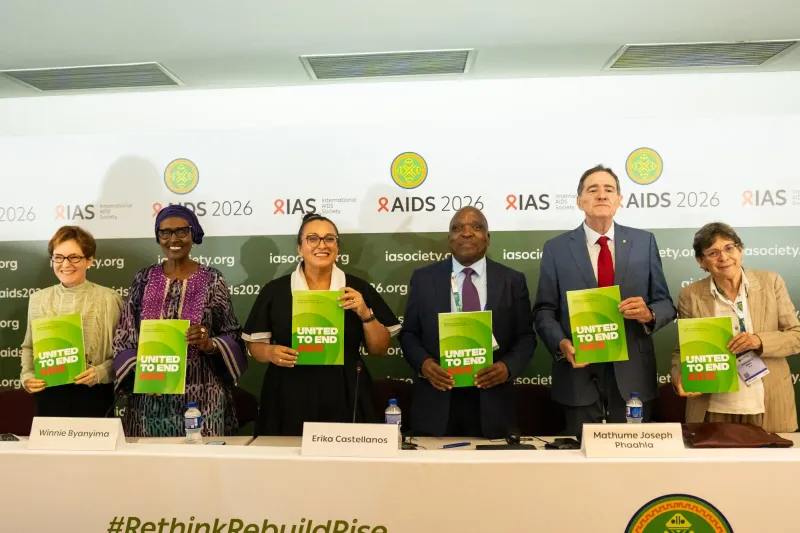




The Joint United Nations Programme on HIV/AIDS (UNAIDS) has warned that deep cuts to international HIV funding are threatening decades of progress against the epidemic, raising concerns that new HIV infections and AIDS-related deaths could rise unless countries restore financing and expand access to prevention and treatment services.
In a special report released during the 26th International AIDS Conference in Rio de Janeiro, Brazil, held from July 27 to 31, UNAIDS said funding disruptions have severely affected HIV prevention, testing and community-led services that support the people most affected by HIV.
According to the report, many countries have been forced to prioritize short-term domestic resource mobilization to maintain essential HIV treatment services after international funding declined. UNAIDS said the full impact of these funding cuts is likely to become clearer over the coming years as countries work to rebuild HIV programmes with new sources of funding.
Despite the challenges, the report noted that new HIV infections and AIDS-related deaths are currently at their lowest levels in more than 30 years. However, UNAIDS cautioned that the global HIV response remains fragile and that efforts to end AIDS as a public health threat by 2030 are at risk unless global solidarity is strengthened and inequalities are addressed.
Uneven progress
UNAIDS estimates that 1.2 million people acquired HIV in 2025. Around 41 million people were living with HIV globally, with approximately 9 million not receiving treatment. Nearly half of all children living with HIV did not have access to antiretroviral therapy, while more than 570,000 people died from AIDS-related illnesses during the year.
Although progress has slowed in some areas, the report highlighted positive achievements. Seven countries—Benin, Eswatini, Kenya, Lesotho, Nepal, Rwanda and Zimbabwe—have reduced new HIV infections by almost 80% since 2010. Additionally, 11 countries achieved the 95-95-95 treatment targets, demonstrating that significant progress remains possible.
New HIV prevention medicines offer hope
UNAIDS said scientific advances are creating new opportunities to prevent HIV infections. Monthly and six-monthly injectable HIV prevention medicines are becoming available, while monthly prevention pills are in late-stage clinical trials.
Executive Director Winnie Byanyima said scientific breakthroughs have provided tools that previous generations could only imagine but stressed that access remains the greatest challenge.
She said innovation without equitable access is not true innovation and emphasized that success will depend on whether people who need the medicines can obtain them at affordable prices.
Brazil increased the number of people accessing HIV prevention medicines at least once in the past year by 41%, while Ethiopia and Uganda expanded access through domestic and other funding. South Africa is continuing negotiations on pricing for the twice-yearly HIV prevention injection lenacapavir.
UNAIDS noted that although Brazil participated in clinical trials for lenacapavir, it has not received voluntary licensing from manufacturer Gilead to support lower-cost pricing or generic production and is considering compulsory licensing.
The report also welcomed efforts by UNITAID, the Global Fund to Fight AIDS, Tuberculosis and Malaria and partners to begin rolling out lenacapavir to reach 3 million people by 2028. However, UNAIDS said this remains far below the estimated 20 million people who need access to antiretroviral-based HIV prevention to significantly reduce new infections.
International funding declines
UNAIDS reported that overseas development assistance declined sharply in 2025, with global development assistance falling by 23%—the largest recorded decline. HIV programmes were among those most affected.
International HIV financing from multiple countries dropped from US$8.8 billion in 2024 to US$7.3 billion in 2025, representing an 18% reduction and the lowest level in nearly two decades.
The report noted that many high-burden, highly indebted, low-income African countries relied on international aid for more than 90% of their HIV response.
Byanyima said the era of relying solely on international aid is over and called for urgent reforms to the global financial system, including accelerated debt restructuring, to enable governments to invest more in health, education and development.
Prevention services under pressure
According to UNAIDS, HIV prevention programmes have been particularly affected because they depend heavily on donor funding. In sub-Saharan Africa, international assistance accounted for 80% of prevention funding.
Community-led organizations, which received up to one-quarter of foreign HIV assistance in 2024, have also experienced significant reductions in support. Surveys cited in the report found that these organizations reached 22% of people living with HIV and up to 60% of marginalized populations with essential services.
The report warned that without renewed donor support and stronger domestic investment, HIV prevention programmes and community-led services face the risk of collapse.
Funding for condoms has also fallen by more than 90% in some countries. A 2026 study covering 47 countries found major reductions in community-led HIV services, including a 50% decline in support for HIV prevention medicines and care, an 85% reduction in services for gay men and other men who have sex with men, an 82% decline in services for sex workers and a 72% reduction in services for survivors of gender-based violence.
Human rights remain central
UNAIDS said increasing criminalization of marginalized populations is undermining the HIV response. According to the report, Burkina Faso and Niger criminalized same-sex sexual activity in 2025, while Senegal increased penalties for same-sex sexual activity in 2026.
The report stated that in 2026, 168 countries criminalized sex work, 152 criminalized possession of small amounts of drugs, 66 criminalized same-sex sexual relations and 14 criminalized transgender people.
Byanyima said ending AIDS is not possible while people living with or at risk of HIV face criminalization, violence and discrimination that discourage them from seeking HIV services.
Renewed commitment to 2030 targets
Despite the challenges, UNAIDS noted that 149 UN Member States adopted a new Political Declaration on HIV and AIDS in June 2026 aligned with the UNAIDS Global AIDS Strategy 2026–2031.
The declaration sets targets of placing 40 million people on life-saving HIV treatment and providing 20 million people with antiretroviral-based HIV prevention by 2030. It also aims to reduce stigma, discrimination, gender inequality, violence and punitive legal barriers affecting people living with or at risk of HIV.
UNAIDS estimates that achieving these commitments could prevent an additional 3.2 million new HIV infections and 1.3 million AIDS-related deaths by 2030.
The agency called on governments and development partners to restore solidarity, sustain financing and protect human rights to keep the goal of ending AIDS as a public health threat by 2030 within reach.





Sunrise reporter
Leave a Comment
Your email address will not be published.