
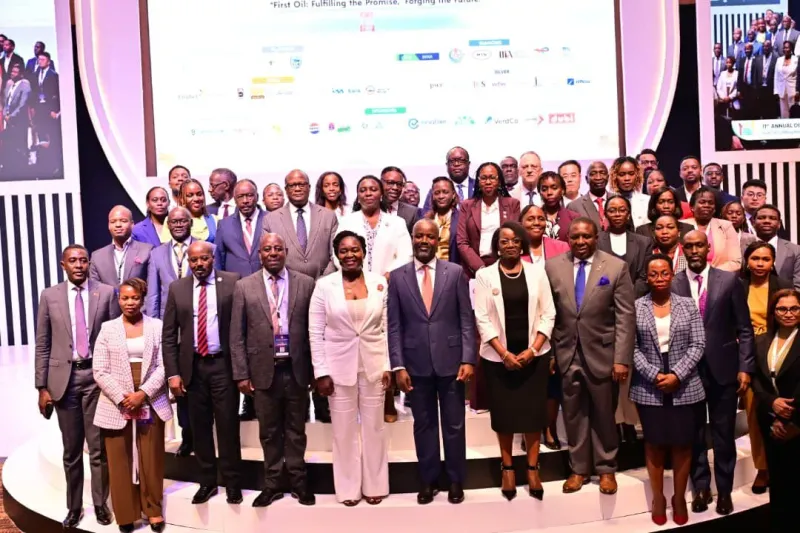
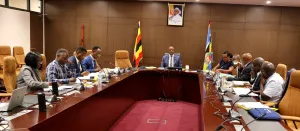


Uganda has moved closer to its First Oil milestone following key announcements at the 11th Annual Oil and Gas Convention held at Speke Resort Munyonyo, where government leaders, industry players, and development partners gathered under the theme “First Oil: Fulfilling the Promise, Forging the Future.”
Deputy Speaker Thomas Tayebwa said the convention comes “at a defining moment in Uganda’s oil journey, as we count down the days to first oil.” He emphasized that oil production will unlock Uganda’s economic potential and support the national ambition of growing from a $50 billion economy to a $500 billion economy by 2040. He further highlighted Parliament’s commitment to providing legislative support and oversight while ensuring transparency, local participation, and meaningful investment opportunities for Ugandans.
A major milestone at the convention was the launch of the National Petroleum Policy 2025, which replaces the 2008 policy framework and provides updated guidance for the entire petroleum value chain as Uganda prepares for production.
Minister of Energy and Mineral Development Ruth Nankabirwa stated that Uganda’s oil and gas sector has moved from potential to execution, noting that “Uganda has made it clear: the conversation has shifted from potential to delivery.” She highlighted progress on key upstream projects including Tilenga, Kingfisher, and the East African Crude Oil Pipeline (EACOP), alongside the $4 billion refinery project expected to process 60,000 barrels per day.
She added that Uganda is entering a long-term 20–30 year investment cycle, opening opportunities across refining, logistics, and operations for both local and international investors.
The Uganda National Oil Company (UNOC) outlined several strategic developments aimed at strengthening Uganda’s role in the sector. Chief Commercial Officer Gilbert Kamuntu emphasized the refinery’s importance in enhancing energy security and enabling downstream industries, noting the need for integrated development across upstream, midstream, and downstream segments to maximize efficiency and value creation.
UNOC Chief Operating Officer Samantha Muhwezi introduced the company’s Technical Services Business, designed to provide engineering, project management, and technical solutions across Uganda’s oil and gas developments. The division will support the full project lifecycle while building local expertise and ensuring international standards, with the goal of retaining more value within Uganda.
During a panel discussion, Eng. David Kasule, Manager of Kabalega Industrial Park at UNOC, confirmed that the park is ready to host investors. He highlighted a range of bankable projects and incentives available, pointing to strong “first mover advantages” for companies entering Uganda’s petrochemical and industrial value chains.
Banage Sarah, Head of Corporate Relations at UNOC, said the planned 60,000 barrels-per-day refinery, expected around 2030, will “fundamentally restructure Uganda’s economy, saving an estimated USD 2 billion annually in petroleum imports.” She added that downstream industries such as plastics, fertilizers, and petrochemicals will help transform Uganda from a net importer into a regional supply hub.
CNOOC Uganda Limited reported continued progress on the Kingfisher Project, which has reached the pre-commissioning stage. Acting President Hu Weijie said operational readiness and workforce training are ongoing as preparations for First Oil continue.
As Uganda approaches this milestone, stakeholders emphasized that the focus has now fully shifted from planning to execution. The developments at the convention reflect a broader national strategy aimed at energy security, industrialisation, local capacity building, and long-term economic transformation.




Sunrise reporter
Leave a Comment
Your email address will not be published.