




Uganda is moving closer to commercial oil production, with the Kingfisher project reaching a major construction milestone while Tilenga and the EACOP pipeline continue to advance.
Uganda's long-awaited oil production is entering a critical phase, with government and industry officials reporting major progress across the country's flagship petroleum projects.
The latest developments at the Kingfisher Development Area in Kikuube District include the completion of major construction works at its Central Processing Facility (CPF), while the East African Crude Oil Pipeline (EACOP) has reached 92.7 percent overall completion.
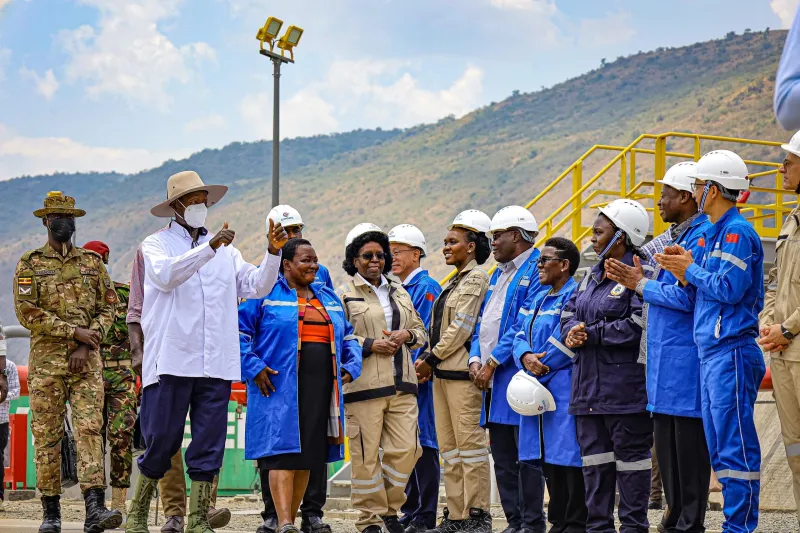
The developments were highlighted during a ceremony at Kingfisher where Uganda's crude oil was formally named ahead of its anticipated entry into international markets.
The Kingfisher Development Area, operated by CNOOC Uganda Limited, has emerged as one of the key projects driving Uganda towards first oil.
CNOOC Uganda's president said the project's Central Processing Facility achieved mechanical completion on August 24, 2026. The milestone means the major construction and installation phase has substantially advanced, allowing the project to move further into commissioning and operational-readiness activities.
Government officials separately reported that Kingfisher was about 80 percent complete overall and approximately 98 percent ready for first oil, with commissioning and testing underway.
The project includes 31 wells across four well pads. Some of the wells extend more than seven kilometres underground, reflecting the technical complexity of developing the Lake Albert oil resources.
The project's designed peak production capacity is 40,000 barrels of crude oil per day. UNOC confirms that the Kingfisher development includes a 40,000-barrel-per-day Central Processing Facility and 31 wells comprising 20 producers and 11 injectors.
CNOOC has also emphasised that the project is intended to build Ugandan expertise alongside production capacity.
Through partnerships with institutions including the Uganda Petroleum Institute Kigumba (UPIK), the company is supporting skills development, knowledge transfer and specialised certification programmes.
The project has also created opportunities for Ugandan businesses involved in construction, transportation, logistics and petroleum-related technical services.
Kingfisher is located southeast of Lake Albert in Buhuka Flats, Kikuube District. Uganda National Oil Company holds a 15 percent participating interest, while CNOOC Uganda operates the project with a 28.33 percent interest and TotalEnergies EP Uganda holding 56.67 percent.
The project is designed to process crude from the Kingfisher field before it is transported through a feeder pipeline to the oil export system.
Earlier technical reporting has confirmed that the CPF is designed to process up to 40,000 barrels per day at peak production.
The project therefore represents an important link between Uganda's oil wells and the wider infrastructure required to move crude towards international markets.
Alongside Kingfisher, the much larger Tilenga project is progressing in the Albertine Graben.
Permanent Secretary in the Ministry of Energy and Mineral Development Irene Bateebe said more than 210 wells had been drilled by July 2026, exceeding the number required to support first oil.
Tilenga, operated by TotalEnergies EP Uganda, is expected to produce approximately 190,000 barrels of oil per day at peak production.
Together, Tilenga and Kingfisher are expected to give Uganda combined peak production of about 230,000 barrels per day. Government information has previously identified this combined capacity as a major component of Uganda's commercialisation strategy.
The pipeline required to transport Uganda's crude to international markets has also moved closer to completion.
EACOP reported on September 1 that the 1,443-kilometre pipeline had reached 92.7 percent overall completion following a supervisory visit by Energy and Mineral Development Minister Monica Musenero Masanza to Pump Station 1 in Hoima.
The pipeline will transport crude from Kabaale in Hoima to the Chongoleani Peninsula near Tanga, Tanzania, where it will connect Uganda's oil production to international markets.
The 47.5-kilometre feeder pipeline connecting Kingfisher to Pump Station 1 has already been laid and buried, according to Bateebe.
The EACOP system is designed to transport Uganda's crude along a 1,443-kilometre route and includes pumping and pressure-reduction facilities needed to move the crude to the export terminal.
The latest completion figure represents a significant increase from the 79 percent reported by EACOP in January and the 91 percent reported in early August, illustrating the pace of work during 2026.
Minister Musenero has urged Uganda to look beyond crude oil exports and use petroleum resources as a foundation for broader economic transformation.
She said the government's immediate objective is to achieve first oil, but the longer-term focus is on ensuring that petroleum generates wider economic benefits through industrialisation, energy security, employment and national development.
The government is also pursuing additional infrastructure around the petroleum industry, including the planned refinery, industrial parks and logistics facilities, particularly in the Albertine region.
The Ministry of Energy and Mineral Development lists Musenero as the current Minister, while Irene Bateebe serves as Permanent Secretary.
Uganda's oil development is also creating employment and skills opportunities.
Musenero said the petroleum sector has generated approximately 39,000 direct jobs and 113,000 induced jobs, with more than 5,000 workers coming from host communities.
She also said more than 14,000 Ugandans have been trained and certified in oil and gas-related disciplines.
The 14,000-plus training figure is consistent with information from the Petroleum Authority of Uganda and other official-sector sources documenting training in areas such as welding, health and safety, heavy goods vehicle operation and scaffolding.
EACOP alone reported that more than 12,000 people had been directly employed across its project, including more than 4,000 Ugandans, by September 2026.
Ugandan companies are also participating in the development through contracts and supply of goods and services. Government figures have previously shown substantial procurement going to Ugandan businesses, reflecting the country's emphasis on national content.
Government officials say first oil should not mark the end of Uganda's petroleum ambitions.
Musenero stressed the importance of continued exploration so that the country's first commercial barrel does not become its last.
The government is preparing for further exploration in prospective areas including the Moroto, Lake Kyoga and Hoima basins, with a third petroleum licensing round expected in 2026.
The broader strategy is to use petroleum revenues and expertise to support industrial development, infrastructure, skills and other productive sectors of the economy.
The completion of major facilities at Kingfisher, progress at Tilenga and the rapid advancement of EACOP mark a decisive stage in Uganda's petroleum development.
For more than a decade, Uganda's oil ambitions have centred on turning discoveries in the Lake Albert region into commercial production.
With the upstream projects moving into commissioning and operational-readiness stages and EACOP now more than 90 percent complete, the focus is increasingly shifting from construction to the practical delivery of first oil.
For Uganda, the bigger challenge will be ensuring that oil production translates into lasting economic value through jobs, local businesses, industrialisation, energy security and responsible management of petroleum revenues.





Sunrise reporter
Leave a Comment
Your email address will not be published.