



Uganda has presented its FY 2026/27 budget, projecting strong economic expansion driven by the start of commercial oil production, rising exports, increased domestic revenue, and expanded investment across priority sectors.
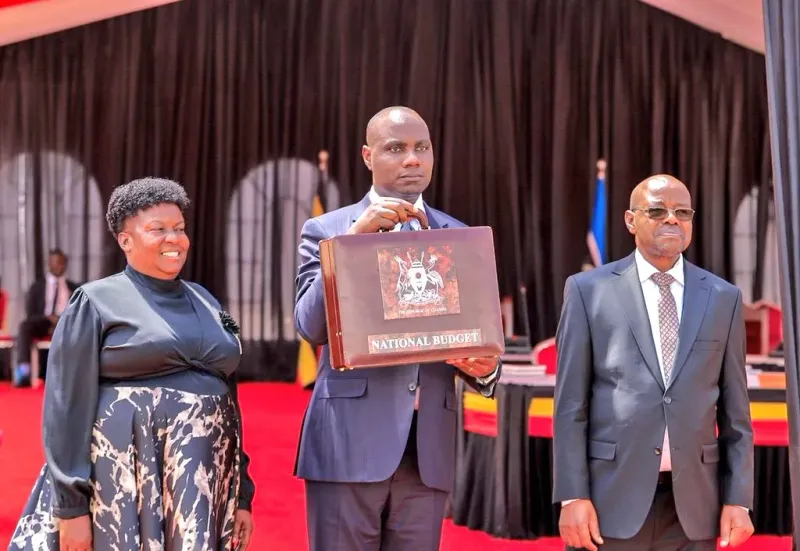
Finance Minister Henry Musasizi delivered the budget speech, outlining government priorities aimed at accelerating economic transformation, job creation, and industrialisation.
Earlier, the Ministry of Finance released the Background to the Budget FY 2026/27, which outlined macroeconomic projections and policy direction, including expected oil production, structural reforms, and expansion of the Parish Development Model (PDM).
Strong Economic Growth Forecast
Uganda’s economy continues to show steady growth momentum, with stronger projections for the coming financial year.
"Economic growth for FY 2025/26 is estimated at 6.4 percent, up from 6.3 percent in FY 2024/25. The size of the economy is projected to increase to approximately USD 69.3 billion, equivalent to Shs 250.4 trillion, by the end of June 2026," Musasizi said.
He added that GDP in purchasing power parity terms stands at USD 197.1 billion, with GDP per capita projected at USD 1,420.
Growth is expected to accelerate to 10.2 percent in FY 2026/27, driven largely by the commencement of commercial oil production.
"This will mark Uganda’s first return to double-digit growth since the reforms of the 1990s," he said.
First Oil to Boost Economic Transformation
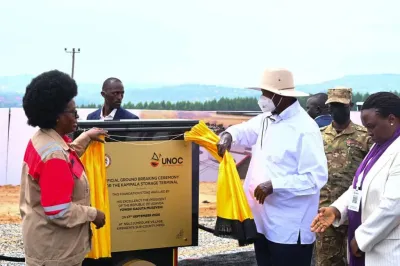
A key highlight of the budget is Uganda’s expected entry into commercial oil production in the first half of FY 2026/27.
Government says this milestone will significantly boost investment inflows, fiscal revenues, and industrial activity, marking a structural shift in the economy.
Export Growth and External Performance
Uganda’s export sector has recorded strong growth over the past five years.
Export earnings increased from USD 5.93 billion in March 2022 to USD 18.04 billion in March 2026, representing a 204 percent rise.
"Our coffee exports reached USD 2.46 billion for the year ending March 2026, up from USD 1.84 billion a year before," the Minister said.
Key exports include gold, coffee, cocoa, fish products, steel products, sugar, and manufactured goods.
Resource Envelope, Financing and Fiscal Position
The total resource envelope for the FY 2026/27 budget is Shs 84,391,743,343,426, according to Finance Minister Henry Musasizi.
Domestic revenues remain the largest source of financing, amounting to Shs 45.96 trillion, of which Shs 40.16 trillion is tax revenue, Shs 4.02 trillion is non-tax revenue, Shs 1.44 trillion is petroleum revenue, and Shs 339.8 billion is Local Government revenue.
Domestic borrowing is projected at Shs 11.97 trillion, while domestic debt refinancing stands at Shs 13.97 trillion.
External financing includes Shs 1.22 trillion in general budget support and Shs 11.27 trillion in project financing.
The Ministry of Finance reported that Uganda’s total public debt stood at USD 34.86 billion, equivalent to approximately Shs 126.19 trillion as of December 2025. Of this, external debt amounted to USD 15.84 billion while domestic debt was USD 19.02 billion. He said this translates into a debt-to-GDP ratio of about 53 percent.
Employment Growth
The government reports continued expansion in both formal and informal employment.
Private formal employment increased from 672,300 workers in FY 2016/17 to over 2,319,683 workers in FY 2024/25.
This is in addition to more than 503,000 public sector jobs and over 10.5 million informal jobs.
Parish Development Model Expansion
The Parish Development Model (PDM) remains a key government strategy to transition households from subsistence production into the money economy.
Government reports that nearly Shs 11 trillion has been invested in wealth creation programmes, with Shs 4.4 trillion distributed across 10,589 parishes.
“By the end of this month, PDM funds will have reached over 4 million beneficiaries,” Musasizi said.
ATMS and Sector Priorities
Government continues to implement the ATMS framework (Agro-Industrialisation, Tourism, Minerals, Science, Technology and Enablers) as a driver of economic transformation.
Agro-Industrialisation
The sector has been allocated Shs 2.26 trillion, the highest to date. Priorities include irrigation, agricultural inputs, research, agro-processing, and market access.
Tourism
Tourism has been allocated Shs 567.32 billion, focusing on branding, infrastructure development, conservation and wildlife protection, hospitality training, and tourism site improvement.
Minerals, Oil and Gas
The sector received Shs 473.51 billion, supporting mineral exploration, mining development, and oil infrastructure, including operationalisation of the East African Crude Oil Pipeline (EACOP) and refinery development.
Science, Technology, ICT and Creatives
Government has allocated Shs 1.140 trillion under STI, ICT and the creative economy.
Priorities include commercialisation of innovations such as Kiira Motors vehicles, coffee value-added products, Dei BioPharma drugs and vaccines, and banana-based products.
Other interventions include establishment of a Hi-Tech City, expansion of research and development (R&D), improvement of digital infrastructure, enhanced e-government services, and promotion of Business Process Outsourcing (BPO) for job creation.
Education Sector Investment
Beginning FY 2026/27, government has allocated an additional Shs 568.65 billion to enhance salaries for primary school teachers, Arts teachers in secondary schools, and BTVET institutions.
Urban Development and Environmental Management
Government will continue implementing urban clean-up initiatives, including restoration of wetlands and green spaces, improved physical planning, pedestrian-friendly roads, enforcement of trade order, and reduction of pollution including noise pollution.
Governance and Implementation Reforms
Finance Minister Henry Musasizi emphasized that achieving the Tenfold Growth Agenda requires discipline, accountability, and efficiency.
Government will implement a comprehensive reform agenda aimed at eliminating waste, corruption, delays, and inefficiency.
Key measures include:
- Enforcement of budget discipline and accountability through performance contracts for Accounting Officers.
- Procurement reforms, digitisation, and strengthened audits.
- Enforcement of trade order and traffic discipline to promote safe, orderly and livable cities and urban centres, and improve the safety of public transport.
- Strengthening governance, oversight and performance of state-owned enterprises.
- Centralizing the management of counterpart funding under the Treasury.
- Implementation of a contributory public service pension fund.
- Suspension of state-funded celebrations on public holidays, except religious holidays.
Uganda’s FY 2026/27 budget presents an ambitious growth strategy anchored on oil production, export expansion, rising domestic revenue, and large-scale investments in productive sectors.
Budget Speech Final Remarks
Finance Minister Musaizi said Uganda has become a land of opportunity and promise.
"Our economy has expanded to USD 69 billion and is projected to grow at double-digit rates,driven by strong export performance, first oil, & sustained wealth-creation interventions. More importantly, this growth is increasingly translating into jobs, higher incomes and better livelihood for Ugandans," said the Minister.
He also noted that Investor confidence is rising, and the Ugandan diaspora is responding with increased remittances, investment and active participation in our transformation.
He said this Budget aims to accelerate the attainment of the Tenfold Growth Strategy,adding that Government has allocated 95.6 percent of discretionary resources to the ATMS (Agro-industrialisation, Tourism Development, Mineral-Based Industrialisation, and Science, Technology and Innovation), and their key enablers.
Government says these priorities aim to transition the economy toward industrialisation, improved productivity, and sustained long-term growth.



Sunrise reporter
Leave a Comment
Your email address will not be published.