

Deputy Inspector General of Government (IGG), Anne Twino, has urged board chairpersons and chief executive officers of public agencies to strengthen institutional oversight, uphold merit-based appointments and enforce anti-corruption measures to support Uganda’s economic transformation.
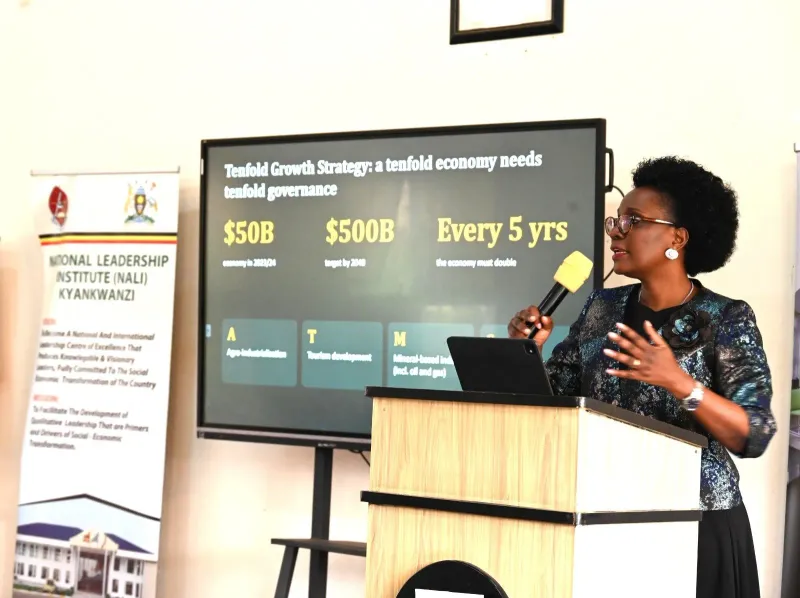
Speaking during the Public Sector Institutions Leadership Retreat at the National Leadership Institute in Kyankwanzi, Twino emphasised the importance of effective governance, accountability and professionalism in public institutions.
The retreat was organised by the Public Sector Chairpersons Forum in collaboration with the Head of Public Service and Secretary to Cabinet.
Twino challenged board chairpersons to embrace the governance principle of “Eyes On, Hands Off”, which requires boards to maintain strategic oversight of institutions without interfering in their day-to-day management.
She stressed that boards should understand institutional strategies, monitor performance and provide guidance, while leaving operational responsibilities to management.
“Management manages while boards govern,” she emphasised.
The Deputy IGG noted that Uganda’s ambition to expand its economy from USD 50 billion to USD 500 billion by 2040 requires strong institutions capable of delivering results through effective leadership and accountability.
“Uganda’s ambition to grow from a USD 50 billion to a USD 500 billion economy by 2040 will not be realised through weak oversight, institutional conflict, or corruption. It requires disciplined, high-performing public institutions,” she said.
Twino cautioned board chairpersons and CEOs against two governance challenges that can undermine institutional performance.
She described the first as the conflict zone, where disagreements and power struggles between boards and management create institutional paralysis and affect service delivery.
The second is the comfort zone, where excessive closeness between board members and management weakens accountability.
She warned that relationships involving favours, trips and employment opportunities for relatives can compromise effective oversight and undermine institutional integrity.
Twino urged the leaders to maintain professional boundaries and ensure that their decisions are guided by transparency, meritocracy and accountability.
The Deputy IGG also highlighted the government's Rationalisation of Agencies and Public Expenditure (RAPEX) policy, which was adopted by Cabinet to streamline more than 150 semi-autonomous government agencies.
The policy aims to eliminate duplication of roles and reduce recurrent government expenditure, with the government already reporting savings of billions of shillings.
She challenged agency leaders to demonstrate their institutions' relevance through measurable performance and improved service delivery rather than relying solely on their establishing laws or lobbying for continued existence.
“The strongest argument for your agency’s continued existence is not your enabling Act. It is not your lobbying. It is performance,” Twino said.
She encouraged public agency leaders to remain efficient, effective and responsive to the needs of Ugandans.
During the interactive session, participants identified external interference, particularly pressure to provide employment opportunities, as one of the challenges affecting their responsibilities.
In response, Twino urged board chairpersons and CEOs to remain committed to meritocracy, integrity and established procedures when making institutional decisions.
She assured participants that the Inspectorate of Government remains available to support public sector leaders as they navigate such pressures.
Twino commended the Head of Public Service and Secretary to Cabinet for organising the retreat at a time when Uganda is implementing its Tenfold Growth Strategy.
She observed that the country's development ambitions depend significantly on the effectiveness and performance of its public sector institutions.
The Deputy IGG attended the retreat alongside Gerald Gwaira, Director of Research, Education and Advocacy; Kakooza Savio Ntensibe, Director of Ombudsman Affairs; Diana Nantabazi, Principal Inspectorate Officer; Lisa Mwagale, Executive Assistant; and Amos Ngwomoya, Public Relations Officer.





Sunrise reporter
Leave a Comment
Your email address will not be published.