
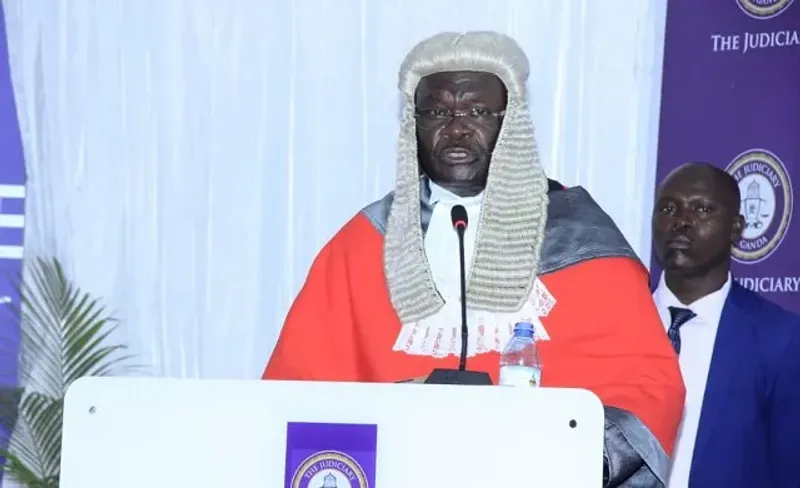

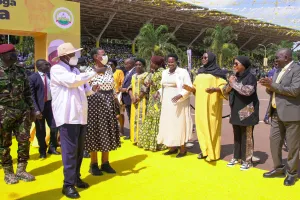
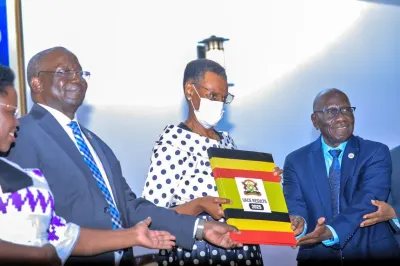
Uganda’s Chief Justice, Alfonse Owiny-Dollo, officially retired on Sunday, January 18, 2026, upon reaching the mandatory retirement age of 70. His retirement marks the conclusion of a distinguished judicial career that has significantly shaped the Ugandan Judiciary over nearly two decades. Owiny-Dollo began his judicial service in 2008 as a High Court judge and later joined the Court of Appeal in 2015. In 2017, he was appointed Deputy Chief Justice and was elevated to Chief Justice in August 2020, succeeding Bart Katureebe.
During his tenure, Chief Justice Owiny-Dollo advocated for reforms aimed at strengthening the judiciary. He successfully pushed for a larger Judiciary budget, which enhanced staffing, infrastructure, and technology across courts. His leadership was marked by a commitment to improving judicial efficiency and maintaining the independence of the judiciary.
Owiny‑Dollo also promoted alternative justice mechanisms such as mediation, plea bargaining and small claims courts to help reduce case backlog and prison congestion. The Judiciary’s push toward reconciliatory and less adversarial dispute resolution gained broader public attention in recent national court engagements.
Anther notable milestone during his leadership was the relocation of the Supreme Court and Court of Appeal to a new, purpose‑built twin‑tower judicial complex in Kampala, aimed at enhancing service delivery and accessibility.
Unlike previous transitions, Owiny-Dollo retired before a successor had been appointed. The Judicial Service Commission (JSC) has forwarded a list of potential candidates to the President for consideration. Contenders for the position of Chief Justice include Justice Mike Chibita, Justice Catherine Bamugemereire, Justice Monica Mugenyi, Justice Christopher Madrama, and Deputy Chief Justice Dr. Flavian Zeija.
Throughout his tenure, Chief Justice Owiny-Dollo faced both achievements and challenges. While widely praised for modernizing the judiciary, his leadership also experienced scrutiny during the 2021 presidential election petition, particularly concerning a dispute involving Supreme Court Justice Esther Kisaakye.
Owiny-Dollo’s professional background includes a Bachelor of Laws, a Diploma in Legal Practice, and a Master’s in Conflict Resolution. Before joining the judiciary, he served as counsel in national peace talks and was a member of the 1995 Constituent Assembly that drafted Uganda’s Constitution. He also represented Agago County in Parliament, highlighting his long-standing contribution to Uganda’s legal and political landscape.
The retirement of Chief Justice Owiny-Dollo concludes a notable chapter in Uganda’s judicial history. His tenure strengthened the Judiciary’s capacity, enhanced transparency in leadership transitions, and left a lasting impact on judicial reform and governance in the country.



The Sunrise Editor
Leave a Comment
Your email address will not be published.