
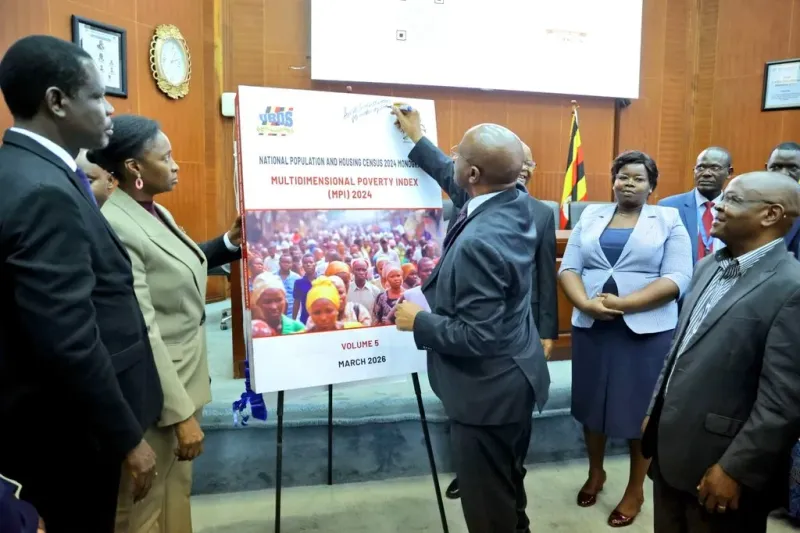




The Multi-Dimensional Poverty Index (MPI) Census Monograph 2024, released by the Uganda Bureau of Statistics (UBOS), highlights that while Uganda has made significant progress in reducing income poverty, multidimensional poverty remains a major challenge. Income poverty has dropped from 56% in 1992/93 to 16.1% in FY 2023/24, yet many Ugandans continue to face deprivations in health, education, living standards, and access to basic services.
Minister of State for Finance, Planning and Economic Development, Hon. Amos Lugoloobi, officiated the launch of the MPI report alongside Dr. Chris N. Mukiza, UBOS Executive Director, and Ms. Irene Mugisha, UBOS Board Member. He emphasized that quality statistics are central for planning, policy formulation, and evaluating national programmes, including the National Development Plan, noting that without reliable data, progress cannot be effectively assessed. Hon. Lugoloobi called on government, private sector, and academia to work collectively to address poverty in all its forms, stressing that focusing on income alone is not sufficient.
Hon. Lugoloobi further highlighted that the depth of data collected during the Census has enabled UBOS to produce multiple monographs, offering critical insights into persistent deprivation, including access to improved sanitation, regional disparities, and household vulnerabilities. He commended UBOS for providing a deeper understanding of poverty beyond income, guiding evidence-based interventions, and supporting targeted resource allocation.
Representing the Parliamentary Committee on Finance, Planning and Economic Development, Hon. Geoffrey Ekanya, MP Tororo North County, noted that poverty trends in sub-regions such as Karamoja, Bukedi, and West Nile have remained consistent over time. He highlighted the importance of statistics in informing policy and budgeting, recalling how previous parliaments used UBOS data, including infant mortality reports, to advocate for targeted interventions and address gender-related disparities. He emphasized that recent national budgets have increasingly aligned with the National Development Plan, guided by UBOS data, strengthening evidence-based planning and decision-making.
The 2024 MPI report shows that national multidimensional poverty stands at 27%, with Karamoja subregion recording the highest MPI at 56.9%, and Kampala the lowest at 8.8%. At the district level, Kaabong district has the highest MPI at 63.9%, while Kampala remains the lowest. Poverty is higher among female-headed households (0.289) compared to male-headed households (26.2%) and is most pronounced among households headed by persons with no formal education (43.5%), while those with education above secondary level have the lowest MPI at 8.2%. Rural areas experience higher poverty at 31.5% compared to 27% in urban areas.
These findings demonstrate that poverty extends beyond income to access to education, health services, safe living conditions, and essential amenities. The MPI provides evidence-based guidance for planning, targeted interventions, and resource allocation, supporting strategies to reduce poverty and improve livelihoods across the country.
While Uganda has made progress in reducing income poverty, the MPI Census Monograph 2024 underscores that multidimensional poverty persists, particularly in rural areas, female- and child-headed households, and among populations with low educational attainment. By leveraging this data, policymakers and stakeholders can implement more effective, targeted strategies to improve living standards, close regional disparities, and safeguard the gains achieved.




Sunrise reporter
Leave a Comment
Your email address will not be published.