
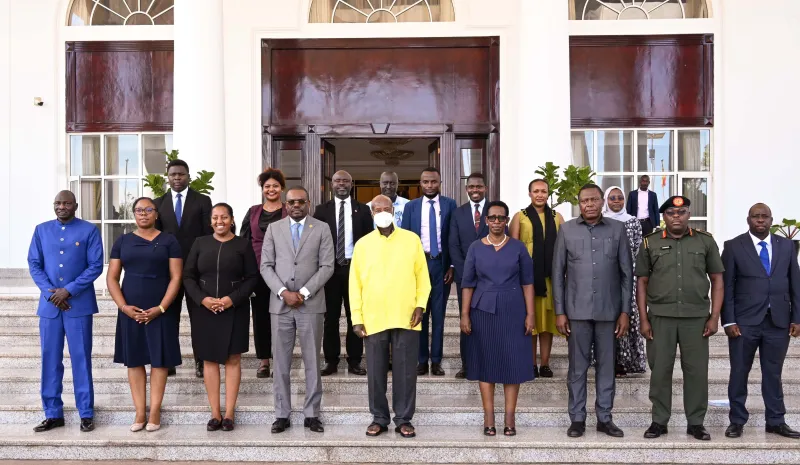

President Yoweri Kaguta Museveni on Friday met a delegation from Africa Centres for Disease Control and Prevention led by Director General Jean Kaseya to discuss the regional Ebola situation and ongoing efforts to strengthen Uganda’s preparedness against the disease.
The meeting, held at State House Entebbe, came a day after Uganda announced strict public health measures following imported Ebola cases linked to travellers from the Democratic Republic of Congo (DRC).
In a statement shared after the meeting, Museveni said the Africa CDC delegation briefed him on the Ebola situation in the region and proposed the establishment of a continental Incident Management Support Team in Kampala to improve regional coordination and monitoring.
“They proposed establishing a continental Incident Management Support Team for Ebola in Kampala to strengthen regional coordination and monitoring efforts, which Uganda welcomes and will support,” Museveni said.
The President also sought to reassure the public, stating that “with proper attention and preparedness, Ebola is very manageable.”
Dr. Kaseya praised Uganda’s response to the outbreak and emphasized the importance of a coordinated continental strategy involving affected and neighboring countries.
“We discussed the Ebola situation in the region and the importance of a strong, coordinated, and united African response,” Kaseya said after the meeting.
He added that following a recent cross-border meeting involving health ministers from DRC, Uganda and South Sudan, African health authorities were developing “one common plan” to guide the collective response to the outbreak.
Uganda’s Ministry of Health on Thursday announced several containment measures after confirming two imported Ebola cases involving Congolese nationals who entered the country from eastern DRC. One of the patients died while another remains under medical care and reportedly tested negative for Ebola in subsequent tests.
The measures approved by the National Task Force include intensified screening and testing along the Uganda–DRC border, enhanced public awareness campaigns, strengthened surveillance systems, and increased monitoring in high-risk districts and the Kampala Metropolitan Area.
Authorities also directed schools to reopen as scheduled while enforcing Ebola prevention standard operating procedures in coordination with nearby health facilities.
The current outbreak has drawn regional and international concern because it involves the Bundibugyo strain of Ebola, for which there is currently no approved vaccine or specific treatment.
The World Health Organization (WHO) recently raised the national risk assessment of the outbreak in DRC to “very high,” warning that the disease may have spread undetected for weeks before confirmation.
According to WHO, Uganda confirmed imported Ebola cases in Kampala on May 15 and May 16 involving travellers from DRC’s Ituri Province, where suspected cases and deaths linked to the outbreak continue to rise.
Health experts say high cross-border movement between Uganda and eastern DRC increases the risk of transmission, prompting intensified regional coordination efforts led by Africa CDC and WHO.
Despite growing concern, Ugandan authorities continue to stress that the situation remains under control due to rapid response systems, surveillance measures, and lessons learned from previous Ebola outbreaks.


Sunrise reporter
Leave a Comment
Your email address will not be published.