
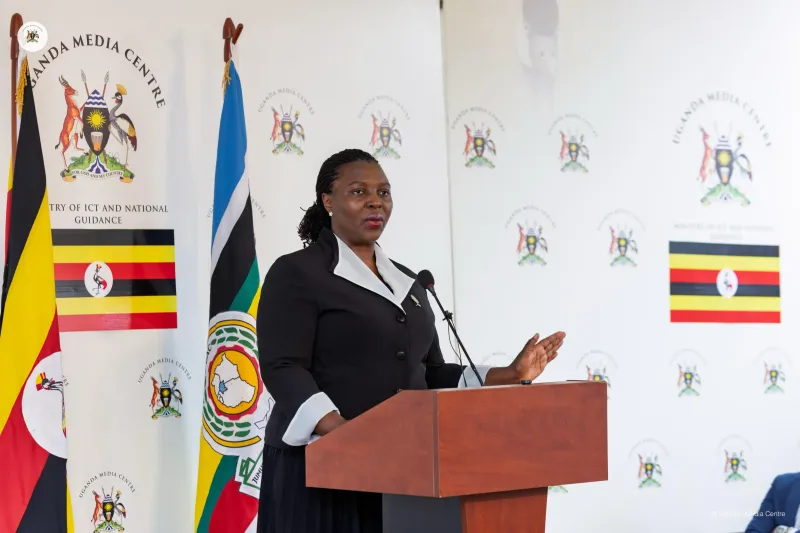





The Ministry of Energy and Mineral Development has reassured Ugandans that the country’s petroleum product supply remains stable despite ongoing global disruptions affecting international oil markets.
Speaking during a press briefing at the Uganda Media Centre, the Permanent Secretary at the Ministry of Energy and Mineral Development, Eng. Irene Bateebe, said instability in the Middle East, particularly around the Strait of Hormuz, has disrupted global oil supply chains and increased international fuel prices, freight charges, and insurance costs.
She explained that East African countries, including Uganda, have been affected because of their dependence on petroleum imports from the Arabian Gulf region. However, she noted that Uganda continues to maintain adequate fuel stock levels to ensure uninterrupted supply across the country.
According to Eng. Bateebe, the Uganda National Oil Company (UNOC), working together with international partners including Vitol, has diversified fuel import sources beyond the Arabian Gulf to include West Africa, Europe, India, and the Americas.
She said the diversification strategy has helped maintain stable fuel availability despite the ongoing international market challenges.
The Permanent Secretary also acknowledged the recent increase in retail fuel pump prices across Uganda. She attributed the price changes to global supply constraints, increased importation costs, exchange rate fluctuations, and rising regional demand.
Eng. Bateebe further noted that Uganda’s comparatively lower fuel prices had temporarily increased cross-border demand from neighbouring countries, creating short-term pressure on fuel availability in some border areas. She, however, confirmed that supply stability has since been restored.
She emphasized that Uganda’s fuel market remains liberalised, with pump prices determined by Oil Marketing Companies, while government continues to monitor the sector to prevent smuggling, ensure fair pricing, and protect consumers from exploitative practices.
The Ministry also urged the public to remain calm, avoid panic buying, and disregard misinformation circulating on social media regarding fuel shortages.
According to the Ministry, Uganda continues to receive regular fuel deliveries through both the Kenyan and Tanzanian supply routes.
On long-term energy security, Eng. Bateebe highlighted several ongoing government investments aimed at strengthening petroleum storage and transportation infrastructure.
She said the Jinja Storage Terminal is being expanded from 30 million litres to 40 million litres, while the Mahathi Infra Terminal on Lake Victoria, with a storage capacity of 70 million litres, continues to improve regional fuel logistics and supply efficiency.
She also revealed progress on the Kampala Storage Terminal in Mpigi District, which will be integrated into the national refined products distribution system connected to the Hoima refinery pipeline network. The terminal is expected to have a storage capacity of 320 million litres.
Regarding downstream petroleum investments, Eng. Bateebe confirmed continued progress on the Uganda Refinery Project located in Kabaale, Hoima District.
The project includes a 60,000 barrels-per-day refinery valued at approximately US$4 billion, a 211-kilometre multi-products pipeline, and associated storage infrastructure.
Government says the refinery project is expected to reduce Uganda’s dependence on imported refined petroleum products while supporting industrial development, petrochemical production, fertiliser manufacturing, LPG development, and job creation.
Eng. Bateebe added that government is also advancing upstream petroleum activities, including preparations for the Third Petroleum Exploration Licensing Round planned for the 2026/2027 financial year.
In addition, new seismic surveys are expected to be conducted in Kasurubani to identify additional petroleum prospects.
On policy reforms, the Ministry confirmed that government has finalised the National Petroleum Policy 2025, replacing the 2008 framework to align the sector with emerging trends in commercialisation, sustainability, regional integration, and the global energy transition.
The Ministry also completed the Petroleum Supply (Liquefied Petroleum Gas Operations) Regulations, 2026, which are expected to strengthen safety standards, regulation, and quality assurance within Uganda’s LPG supply chain.
Eng. Bateebe reaffirmed government’s commitment to ensuring long-term energy security, stable fuel supply, and maximising national benefits from Uganda’s petroleum resources through continued investments in refining, storage, exploration, and petroleum infrastructure development.




Chrispus Mutaahi
Leave a Comment
Your email address will not be published.