
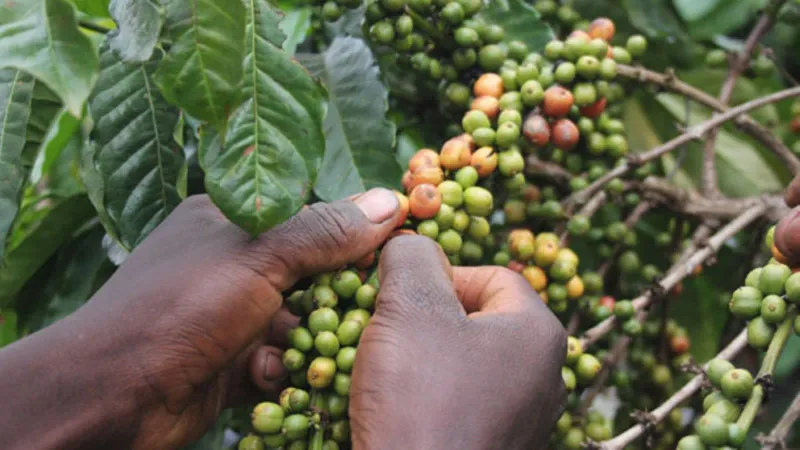




The Ministry of Agriculture, Animal Industry and Fisheries (MAAIF) has sought to calm concerns over falling coffee and cocoa prices, saying the recent market volatility is being driven largely by changes in global supply, inventories and production expectations rather than a collapse in demand.
In a statement issued on September 20, 2026, Agriculture Minister Frank K. Tumwebaze said international developments were having a direct impact on prices paid to Ugandan farmers.
Coffee and cocoa are globally traded commodities, meaning Uganda's domestic prices are influenced by production, weather, inventories, currencies, shipping and purchasing decisions in major producing and consuming countries, the minister said.
The biggest pressure has been felt in Uganda's Robusta market.
MAAIF said average farm-gate prices for Robusta FAQ declined from Shs13,500–14,000 per kilogramme in September 2025 to Shs11,500–12,000 per kilogramme in the first half of September 2026.
Using the ministry's midpoint comparison, the change represents a decline of about 14.5 percent.
Robusta Kiboko prices also fell from Shs6,000–7,000 per kilogramme last September to Shs5,000–6,000 during the first half of this month.
The situation is different for Arabica.
MAAIF reported that Arabica parchment increased from Shs14,000–15,000 per kilogramme in September 2025 to about Shs15,500–16,000 in the first half of September 2026.
Based on the ministry's midpoint figures, that amounts to an increase of approximately 8.5 percent.
The Uganda Coffee Development Authority's published market information also shows that domestic coffee prices vary significantly by grade and form, underlining the importance of quality and processing when comparing prices received by farmers.
MAAIF attributed part of the recent international pressure to increased availability from major producers, particularly Brazil and Vietnam.
The ministry said Arabica prices had fallen to about $3.03 per pound by September 3, while Robusta was around $3,426 per tonne.
The International Coffee Organization has also described a market in which expectations of increased supply and favourable rainfall in Brazil have recently eased upward pressure on prices. Its August 2026 report put the ICO Composite Indicator Price at an average of 287.29 US cents per pound, virtually unchanged from July.
Brazil's 2026/27 production outlook also points to a larger overall crop. A USDA Foreign Agricultural Service report projected Brazilian coffee production at 71.9 million 60-kg bags, 14 percent above its estimate for the previous marketing year.
This provides some independent context for MAAIF's explanation that increased global availability is contributing to current price pressure.
The price concerns come as Uganda recorded a significant year-on-year fall in coffee shipments in July.
The country exported 846,376 bags of 60 kilogrammes in July 2026, compared with 997,105 bags in July 2025.
That represents a decline of about 15.1 percent in volume.
Coffee export earnings also fell from $250.7 million to $204.1 million, a decrease of approximately 18.6 percent.
The figures were independently reported by Reuters from Ministry of Agriculture data.
MAAIF now links the domestic supply situation partly to prolonged dry conditions and unusually high temperatures in some coffee-growing areas.
The ministry identified parts of Greater Masaka, Kyotera, Sembabule and Luwero among areas affected by water stress.
According to the ministry, the adverse weather has affected flowering, cherry development, bean filling and coffee processing out-turn, with affected areas estimated to be operating about 10 percent below normal out-turn levels.
Despite the decline in some coffee prices, Tumwebaze said farmers should not automatically interpret the lower farm-gate price as a loss-making situation.
A farmer receiving Shs12,500 per kilogramme instead of Shs13,750, for example, is earning less per kilogramme than before, but whether the farmer is making a profit depends on production costs, yields, quality, post-harvest handling and how the coffee is sold.
MAAIF said farmers who improve productivity and undertake basic value addition can reach break-even at an FAQ price of about Shs7,000 per kilogramme.
However, the ministry acknowledged that farmers whose production has been severely affected by drought may face substantial financial losses.
With traders becoming more selective, MAAIF is urging farmers not to respond to falling prices by harvesting immature coffee.
The ministry said properly harvested, dried and graded coffee can attract better prices than immature, poorly dried or mixed coffee.
Tumwebaze urged farmers to maintain quality and move beyond selling raw Kiboko where possible by improving processing and grading.
The warning comes as Uganda seeks to strengthen its position in international specialty and commercial coffee markets.
In June 2026, Uganda launched its first national coffee brand, “Uganda Coffee: It's in Our Nature,” at World of Coffee in Brussels. The government said the brand is intended to promote Uganda as an identifiable coffee origin in international markets.
Cocoa has also experienced significant volatility in international markets.
MAAIF said recent price declines followed a period of strong price increases and were associated partly with expectations of improved supplies.
The ministry pointed to increased cocoa production and shipments from Ivory Coast as one factor behind the changing market outlook.
Recent data from the International Cocoa Organization confirms sharp price movements. Its figures show New York cocoa falling from $6,085.33 per tonne on September 16 to $5,764.33 on September 17, while the London price also declined over the same period.
MAAIF said cocoa prices, like coffee, would remain highly sensitive to weather and production conditions in major producing regions.
The government says its response will not focus only on prices.
MAAIF plans to continue monitoring international and domestic coffee prices and providing indicative market information while supporting the rehabilitation of existing coffee gardens and establishment of new ones.
The ministry also said government is providing fertiliser and other productivity-enhancing inputs in key producing areas.
Irrigation is another major part of the government's response to changing weather conditions. MAAIF says it is working with the Ministry of Water and Environment and other government agencies to expand access to water for agricultural production.
The ministry also cited the Climate Smart Agricultural Transformation Project, under which farmers are being supported with improved planting materials, technologies, water-management practices and knowledge intended to strengthen adaptation to changing climatic conditions.
Looking ahead, Tumwebaze said international coffee and cocoa prices would continue to depend heavily on supply and weather developments.
Brazil's coffee harvest and Vietnam's Robusta exports are expected to remain important factors for the Robusta market, while weather disruptions or lower-than-expected production could tighten global supplies.
For cocoa, production conditions in West Africa will remain important.
The minister said government considers it reasonable to expect some price recovery and greater stability over the next six months, although this outlook depends on how global supply, weather and inventories develop.
For now, MAAIF's message to farmers is to avoid panic selling, maintain coffee quality and invest in productivity where possible.
The ministry says Uganda's coffee sector continues to have international demand despite the current price correction, while the government works to address the production and climate challenges affecting farmers.





Sunrise reporter
Leave a Comment
Your email address will not be published.