
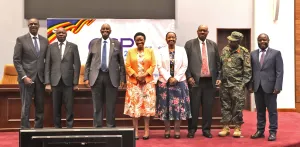
Uganda and the World Bank have agreed to accelerate the implementation of a US$4.6 billion development portfolio covering 18 operations, as the two sides seek to overcome delays and ensure approved financing delivers projects and services on the ground.
The agreement was reached during the Uganda–World Bank Country Portfolio Performance Review held at the Sheraton Hotel in Kampala. The meeting examined the progress of World Bank-supported programmes, identified obstacles slowing implementation and set out measures to improve delivery.
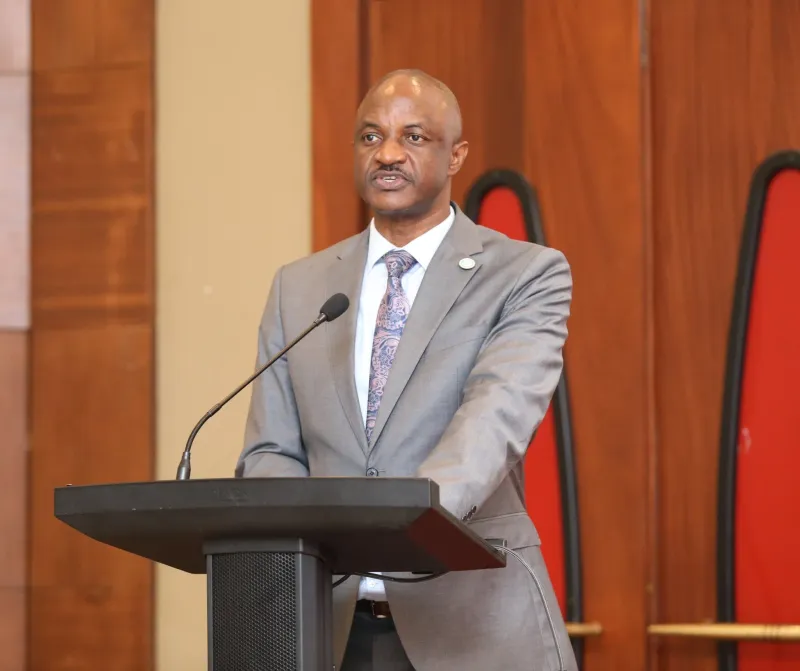
Uganda’s Permanent Secretary and Secretary to the Treasury (PSST), Dr. Ramathan Ggoobi, said the government is carrying out a detailed assessment to establish whether delays are caused by limited funding or weaknesses in project management.
The assessment will examine issues including procurement, project designs, land acquisition, counterpart funding, approvals and contract management.
Dr. Ggoobi said the exercise is intended to provide measurable evidence on the source of implementation delays rather than treating all challenges as funding constraints. He pointed to inadequate project preparation before financing commitments are made as one of the factors contributing to slow implementation.
The PSST said some projects only reach the stage of physical works several years after they are approved. This reduces the time available for implementation and can result in extensions, unfinished activities and additional costs for government.
To address the problem, the government has strengthened project gatekeeping under the Public Investment Management System.
Projects are expected to meet key readiness requirements before negotiations, while implementation conditions must be satisfied before financing agreements are signed.
Among the requirements are approved procurement plans, completion of environmental and social safeguards, and acquisition of the necessary rights-of-way.
The PSST also highlighted the expansion of electronic government procurement as part of efforts to improve efficiency, transparency and accountability in public projects.
He said all Programme-for-Results operations are required to use the electronic procurement system, while discussions with the World Bank will continue on extending its use to other projects.
The government is also facing a tighter implementation timetable, with nine projects expected to close in 2027 and 2028.
Dr. Ggoobi said projects that cannot realistically be completed within the remaining period should be considered for restructuring, scaling down or cancellation.
Extensions, he said, should primarily be used where they are necessary to meet existing contractual obligations.
The World Bank says its financial partnership with Uganda has expanded significantly over the past two years.
Qimiao Fan, the World Bank Division Director responsible for Uganda, Kenya, Somalia and Rwanda, said nearly US$2 billion in new commitments had been added to Uganda's portfolio during the period.
Fan said Uganda's portfolio is among the largest International Development Association portfolios in Africa and the second largest within his unit.
About US$3.1 billion remains available for disbursement, an amount equivalent to approximately five percent of Uganda's gross domestic product, according to the World Bank official.
The available financing is aligned with Uganda's Tenfold Growth Strategy, the National Development Plan and the World Bank's FY2026–FY2035 Country Partnership Framework.
The framework prioritises areas including governance, human capital development, connectivity, private-sector productivity and the creation of jobs.
World Bank Senior Operations Officer Tonderai Fadzai Mukonoweshuro said six operations approved during Uganda's 2025/2026 financial year had added nearly US$2 billion to the portfolio.
However, he said the new operations had barely begun disbursing funds, highlighting the need to move quickly from approval and preparation to implementation.
The portfolio review is expected to result in a specific improvement plan for each operation. The plans will identify the actions required, the institutions responsible, financing implications and implementation deadlines.
Projects that continue to perform poorly could ultimately face restructuring or termination.
The latest push comes as Uganda seeks to turn approved development financing into completed infrastructure, improved public services, private-sector opportunities and other measurable development outcomes. Recent government figures have similarly highlighted low disbursement rates and implementation challenges within the World Bank portfolio.


Sunrise reporter
Leave a Comment
Your email address will not be published.