
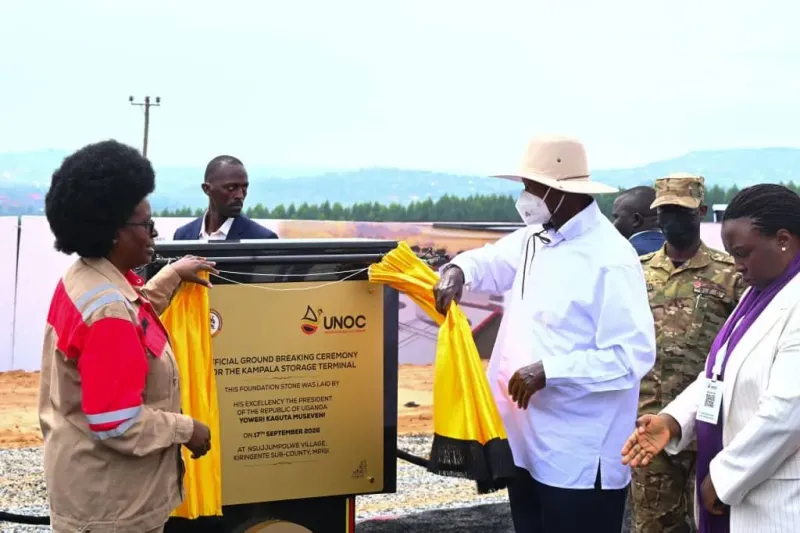




Uganda has begun construction of the Kampala Storage Terminal (KST) in Namwabula, Mpigi District, in a major investment aimed at expanding the country’s petroleum storage capacity and strengthening fuel supply security.
President Yoweri Kaguta Museveni presided over the groundbreaking ceremony on Thursday, September 17, as Uganda National Oil Company (UNOC) advanced the US$310 million petroleum storage project.
The terminal, being developed on about 300 acres, is designed to store up to 320 million litres of petroleum products, including petrol, diesel, jet fuel and kerosene. The facility is expected to serve Kampala, the Central Region and other parts of Uganda once completed.
Uganda currently consumes more than 240 million litres of petroleum products each month, according to figures from UNOC.
The new terminal will significantly increase the volume of petroleum products that can be held within the country. It will complement the Jinja Storage Terminal, whose capacity is being expanded from about 30 million litres to approximately 40 million litres.
Energy and Mineral Development Minister Monica Musenero said the KST is intended to give Uganda a stronger buffer against international market disruptions, supply interruptions and other emergencies affecting petroleum availability.
Once the KST and the Jinja expansion are completed, Government and UNOC-managed storage capacity is expected to reach approximately 360 million litres, according to officials.
The Kampala Storage Terminal is being developed as part of a wider petroleum infrastructure network.
UNOC says the facility is expected to receive both imported petroleum products and products refined locally once Uganda's planned refinery becomes operational.
The project also incorporates the proposed Mpigi Remote Refinery Terminal (MRRT), which is intended to receive, store and dispatch petroleum products transported from the Hoima area.
The terminal is planned to connect to the refinery through a proposed 211-kilometre multi-products pipeline linking the petroleum infrastructure in Hoima with the storage and distribution facilities in the central part of the country.
This would eventually create a connected supply chain stretching from Uganda's oil-producing region to the refinery, storage facilities and consumers.
The KST is not being developed as a standalone facility.
Government has also outlined plans to establish three regional petroleum storage facilities, with the aim of positioning strategic fuel stocks closer to different parts of the country.
Uganda is also exploring additional petroleum supply routes, including logistics through Lake Victoria. The Ministry of Energy and Mineral Development has said these measures are intended to diversify supply routes and improve the country's ability to respond to external disruptions.
The government has also been improving other parts of the petroleum logistics system. In May 2026, the Ministry said Uganda was maintaining supply through the Kenya and Tanzania routes while working to strengthen storage and diversify sources of petroleum products.
Beyond strategic reserves, the Kampala Storage Terminal is expected to provide storage and handling services for oil marketing companies.
The facility is also expected to support UNOC's role in sourcing and distributing petroleum products and could eventually serve as a distribution point for the domestic and regional markets.
Officials say the project will require supporting infrastructure, including road access, electricity, ICT connectivity, water and railway links.
The terminal is expected to handle a large volume of road traffic once operational, with officials estimating that it could accommodate around 450 fuel trucks a day.
The KST project comes as Uganda moves closer to developing an integrated domestic petroleum industry.
Government is advancing plans for the refinery at Kabaale in Hoima District, together with associated pipeline and storage infrastructure. The Ministry has previously said the planned refinery is designed to process 60,000 barrels of crude oil per day and will be connected to a 211-kilometre multi-products pipeline.
The storage terminal is therefore expected to become an important downstream link once the wider infrastructure is completed.
Uganda also recently named its crude oil “Pearl Sweet”, another milestone in the country's preparations for petroleum production and development of the sector.
The immediate significance of the KST is its planned ability to hold much larger volumes of fuel inside Uganda.
A larger domestic storage buffer can give authorities and petroleum suppliers more room to respond when imports are delayed or international supply chains experience disruption.
However, the terminal itself will not eliminate all factors affecting fuel prices. Pump prices can also be influenced by international petroleum prices, taxes, exchange rates, transport costs and other market conditions.
For Uganda, the broader objective is to develop a petroleum system that can receive imported products while also accommodating locally refined fuel in the future.
With construction now underway, attention will turn to the delivery of the terminal and the development of the refinery, pipeline and other infrastructure required for the planned integrated petroleum network to become fully operational.






Marlene Luwedde
Leave a Comment
Your email address will not be published.