
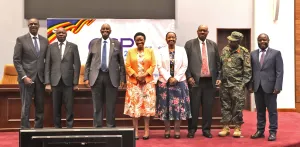
The Ministry of Finance, Planning and Economic Development has called on local governments to strengthen accountability, improve budget implementation and ensure public resources translate into better services and improved livelihoods for citizens.
The call was made on Thursday, as the ministry commenced consultations for the FY 2027/28 Local Government Budget in Uganda’s Central Region.
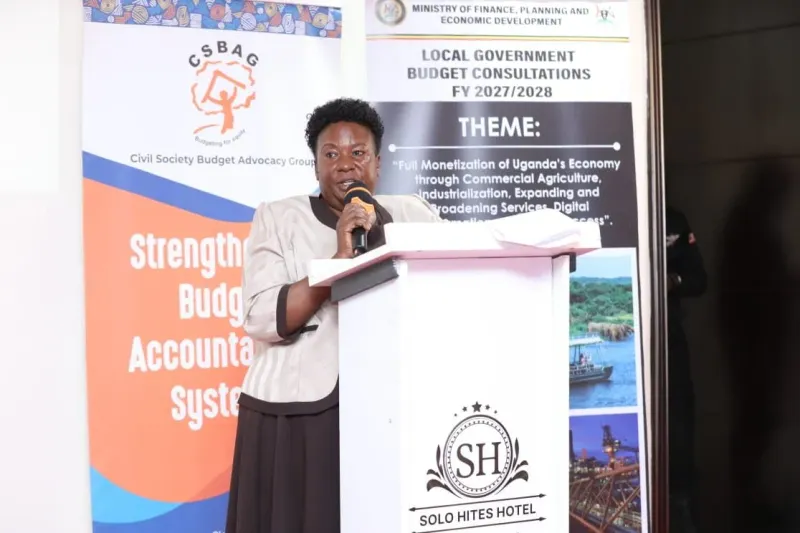
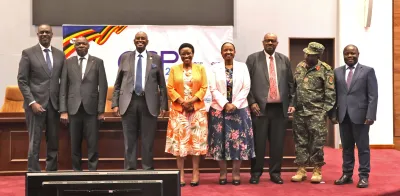
The two-day consultations, being held at Solo Heights in Masaka from September 17 to 18, have brought together Resident District Commissioners, district chairpersons, chief administrative officers, technical officers, development partners and civil society representatives.
Participants include officials from Lwengo, Kalungu, Gomba, Kyotera, Masindi and Makindye-Ssabagabo.
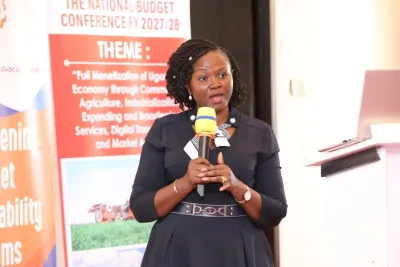
Speaking during the consultations, the Minister of State for Finance, Planning and Economic Development in charge of General Duties, Hon. Cissy Mulondo, said the discussions should result in practical measures that improve service delivery and ensure government programmes produce tangible benefits for communities.
The consultations provide local governments with an opportunity to assess implementation of the current budget, identify service delivery gaps and contribute to priorities for the FY 2027/28 Budget Strategy.
The process is being conducted in accordance with Article 155 of the Constitution of Uganda and the Public Finance Management Act, Cap. 171.
Mulondo said the government has continued to respond to concerns raised by local governments through targeted funding allocations.
Among the allocations highlighted are Shs13.2 billion for the induction of political leaders, Shs32 billion for vehicles for accounting officers, Shs16.05 billion for the Planning Grant and Shs64 billion for physical planning and public infrastructure coordination.
The government has also allocated Shs15.8 billion to equip extension workers, Shs20 billion for ambulances and Shs9.5 billion for tourism development.
Other allocations include Shs250 billion for Greater Kampala infrastructure under UCMID, Shs59.5 billion for urban roads and drainage in the six largest districts and Shs6 billion for road maintenance.
Despite the funding interventions, the minister identified several challenges that continue to affect service delivery at the local government level.
These include staff absenteeism, weak supervision, unspent wage resources amid staffing gaps, procurement delays, weaknesses in contract management, misuse of resources and inadequate maintenance of infrastructure.
Mulondo urged local governments to prepare focused, realistic and results-oriented budgets, with greater attention to accountability and measurable outcomes.
The government has also emphasised that budget performance should ultimately be reflected in improved public services and community outcomes rather than simply in the rate at which allocated funds are spent. A contemporaneous report on the consultations similarly highlighted concerns over wasteful spending and poor service delivery.
The FY 2027/28 Budget will be guided by the government's Tenfold Growth Strategy and seven strategic shifts.
These include revenue-led fiscal consolidation, prudent management of oil revenues, accelerated implementation of Agro-Industrialisation, Tourism, Minerals and Science, Technology and Innovation (ATMS), job creation, strengthening the Parish Development Model and other government programmes, and enforcement of budget reforms.
According to the minister, local governments have a critical role in translating national priorities into increased production, investment, employment, household incomes and improved services at community level.
Local governments are required to submit their FY 2027/28 Budget Framework Papers by November 13, 2026, in accordance with the Public Finance Management Act.
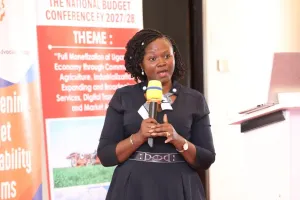
The consultations are being held under the theme: “Full Monetisation of Uganda’s Economy through Commercial Agriculture, Industrialisation, Expanding and Broadening Services, Digital Transformation and Market Access.”
The Central Region consultations are expected to help local governments identify service delivery gaps, refine their priorities and contribute to the preparation of Uganda's next budget.


Sunrise reporter
Leave a Comment
Your email address will not be published.