


Finance Minister Henry Musasizi has explained how Uganda intends to implement its new Charter for Fiscal Responsibility for the five-year period covering financial years 2026/27 to 2030/31.
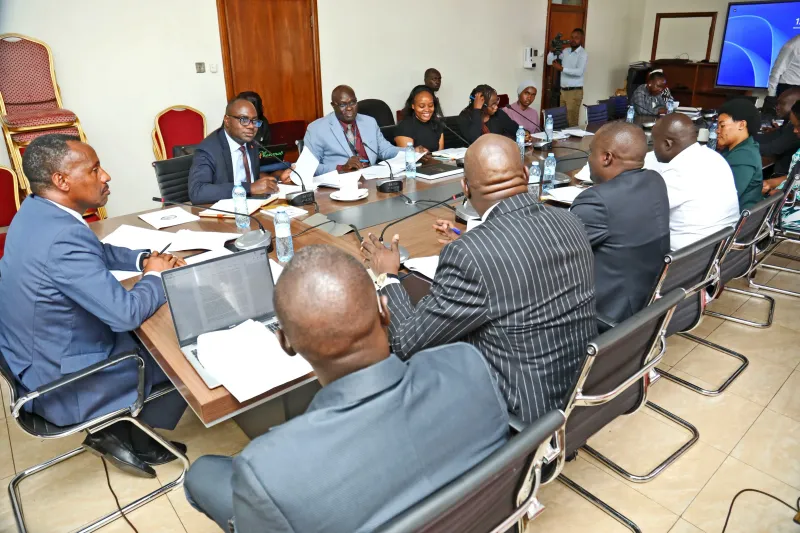
Musasizi made the clarification while appearing before Parliament’s Budget Committee, which was reviewing the Charter and issues raised by various institutions.
The fiscal framework is intended to guide Government decisions on budgeting, borrowing, expenditure and management of public finances over the next five years.
One of the issues discussed was the difference between debt projections by the Ministry of Finance and the Bank of Uganda.
The Ministry has projected public debt at 54.7% of non-oil GDP for FY2026/27, while a 57.7% figure has been attributed to the Bank of Uganda.
Musasizi said the Ministry of Finance, Bank of Uganda and Uganda Bureau of Statistics (UBOS) normally harmonise their debt estimates during the annual Debt Sustainability Analysis after final GDP figures for the completed financial year are available.
He said the Ministry remains responsible for official debt reporting and projections through the Annual Debt Sustainability Analysis and related reporting framework.
According to Musasizi, the difference could partly arise from how domestic arrears are treated.
He noted that the Ministry's debt sustainability analysis does not include the stock of domestic arrears in line with international debt measurement practices.
Under the framework used by Government, public debt covers central Government obligations. External debt is measured using the nominal amount disbursed and outstanding, while domestic debt is valued at cost.
Although domestic arrears and temporary advances from the Bank of Uganda are excluded from the international definition of public debt, their associated risks are captured in the annual Fiscal Risk Statement.
The Charter projects public debt to reach a peak of 55.1% of non-oil GDP in FY2027/28 before gradually declining to 50% by FY2030/31.
Musasizi also clarified how petroleum revenues will be handled under the new fiscal framework.
He said the petroleum revenue rule does not override the Public Finance Management Act but establishes the annual amount of petroleum revenue that can be used to finance budget operations.
Under the rule, transfers from the Petroleum Fund to the Consolidated Fund will be limited to 0.8% of the previous year's estimated non-oil GDP outturn as provided by UBOS.
Any petroleum revenue remaining after the permitted transfer will be placed in the Petroleum Revenue Investment Reserve.
The Charter sets out a gradual reduction in Uganda's fiscal deficit excluding oil revenue.
The deficit is projected to decline from 6.6% of non-oil GDP in FY2026/27 to 1.5% by FY2030/31.
Musasizi said the adjustment is deliberately weighted towards the later years because revenue improvements expected from the Domestic Revenue Mobilisation Strategy are expected to take time to materialise.
At the same time, expenditure associated with the start of oil production is expected to be concentrated in the earlier years of the fiscal framework.
If projected revenue improvements do not materialise, the Government plans to respond through expenditure reprioritisation, controlling non-priority recurrent spending and, where necessary, introducing additional revenue measures.
The Minister said the Government would avoid addressing revenue shortfalls primarily through additional borrowing.
The Charter also sets targets for reducing reliance on commercial borrowing.
Commercial borrowing as a share of domestic non-oil revenue is projected to fall from 33.7% in FY2026/27 to 19.3% by FY2030/31.
Total interest payments are also projected to decline from 32.5% to 20% over the same period.
Musasizi said the Charter establishes the broad fiscal limits, while specific decisions on borrowing and the management of interest-rate, refinancing, foreign-exchange and private-sector credit risks will continue to be handled under the Government's debt management framework.
Implementation of the five-year fiscal framework will be monitored through the national budget process, macroeconomic modelling and economic forecasting.
The Ministry of Finance, Planning and Economic Development will report progress to Parliament through its regular fiscal performance reports.
The Half-year Fiscal Performance Report is expected by the end of February each year, while the Annual Fiscal Performance Report will be presented by the end of October.
The reporting mechanism is intended to allow Parliament to monitor whether Government is meeting the fiscal targets set under the Charter for the 2026/27 to 2030/31 period.





Sunrise reporter
Leave a Comment
Your email address will not be published.