
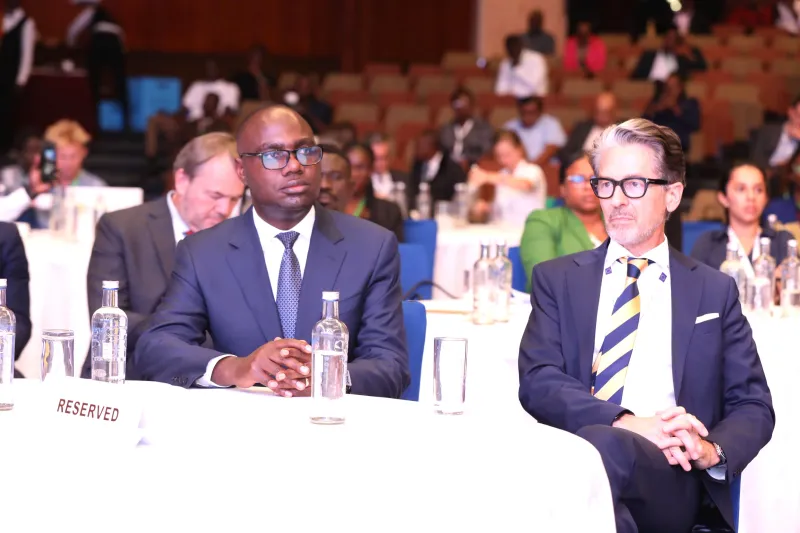



Uganda has called on European Union (EU) investors to increase investment in the country’s energy sector to accelerate renewable energy development, support industrialization and help achieve its ambition of building a US$500 billion economy by 2040.
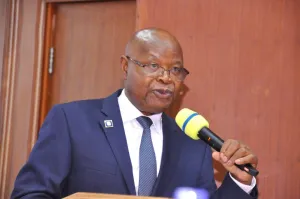
Finance Minister Henry Musasizi made the call while closing the first day of the two-day Uganda-EU Business Forum at Serena Hotel in Kampala. The forum was held under the theme “Driving Investment, Renewable Energy Partnership and Green Industrialization under the Global Gateway Strategy.”
Musasizi said reliable and adequate electricity supply is essential to implementing the government’s Tenfold Growth Strategy, which prioritizes agro-industrialization, tourism development, mineral development, including oil and gas, and science, technology and innovation.
Uganda is targeting electricity generation capacity of 20,000 megawatts (MW) by 2040 as the government seeks to expand power supply to support industrial growth and economic transformation.
The national budget for the 2026/27 financial year has allocated Shs 2.1 trillion to energy development, with priorities including the 380MW Kiba Hydropower Project, a 10MW floating solar plant at Isimba and at least 500MW of utility-scale solar projects in the Elgon and Acholi regions.
The government also plans to expand electricity transmission infrastructure to serve industrial parks and export processing zones, improving power access for businesses and supporting increased production.
Musasizi highlighted opportunities for European investors in hydropower, geothermal, solar, wind and nuclear energy, as well as technology transfer, manufacturing and value addition.
He revealed that Uganda has identified 27 geothermal sites with an estimated energy potential of 1,500MW, presenting further opportunities for investment in renewable and alternative energy sources.
According to the minister, diversifying Uganda’s energy mix would strengthen the manufacturing sector, improve export competitiveness and enable the country to produce higher-value goods.
He also called for stronger commercial ties between Uganda and the European Union, pointing to growth in trade between the two sides. Uganda’s exports to the EU increased from approximately €500 million in 2019 to €1.8 billion in 2025, while the country’s exports of goods and services reached US$18.4 billion in the 2025/26 financial year.
Musasizi urged European investors to explore joint ventures, public-private partnerships and technology acquisition to support Uganda’s development priorities. He also called for greater market access for Ugandan value-added products, saying such opportunities could help stimulate productivity, create jobs and drive economic growth.
EU Ambassador to Uganda Jan Sadek reaffirmed the European Union’s commitment to mobilizing financing and strengthening partnerships with Uganda under the Global Gateway strategy.
Sadek said turning Uganda’s energy potential into actual investment would require bankable projects, predictable regulations and financing mechanisms capable of reducing risks for private investors.
He encouraged businesses, financial institutions and public agencies participating in the forum to take advantage of matchmaking and deal-making sessions to establish partnerships and move viable projects towards implementation.
Uganda’s push to expand electricity generation to 20,000MW by 2040 places energy investment at the centre of its industrialization agenda, with the government seeking international partnerships to develop power infrastructure, expand renewable energy and support the production of goods for domestic and export markets.





Sunrise reporter
Leave a Comment
Your email address will not be published.