
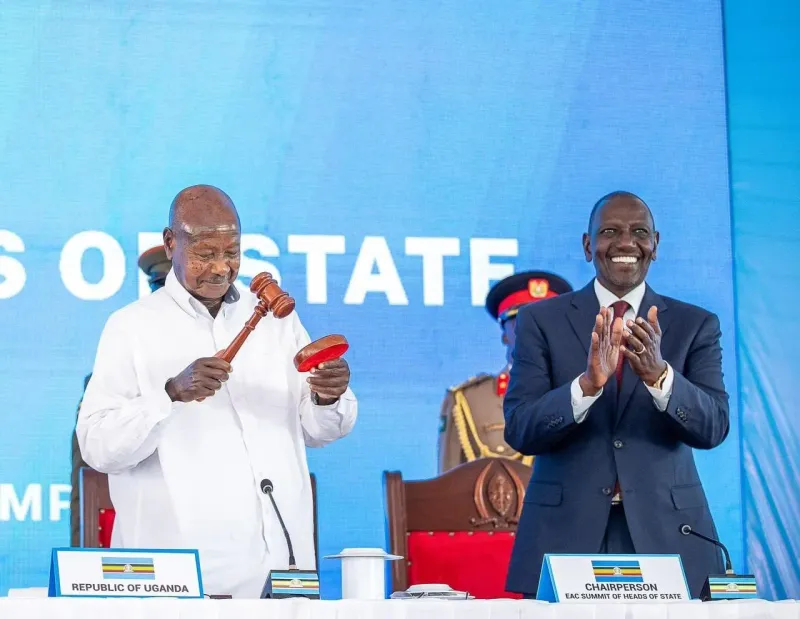


Yoweri Kaguta Museveni, President of Uganda, has officially assumed the chairmanship of the East African Community (EAC), taking over from William Ruto, President of Kenya.
The leadership transition was announced during the 25th Ordinary Summit of EAC Heads of State held in Arusha, Tanzania.
Museveni will serve as the regional bloc’s chairperson for a one-year term, marking the fourth time he has held the position.
New Decision-Making Approach in the EAC
During the summit, leaders discussed challenges related to decision-making within the regional bloc as membership continues to expand.
Speaking at the meeting, President Ruto said the EAC had adopted a new approach to improve efficiency.
“It is increasingly becoming difficult to get consensus of all countries now that we are eight and counting. We have therefore taken the decision that decisions of the community will be made by consensus or by 65 percent of members,” Ruto said.
The change aims to streamline decision-making within the community as it continues to grow.
Trade Within the EAC Continues to Grow
According to Ruto, trade among EAC member states has continued to expand in recent years.
Regional trade reportedly increased from $33 billion in 2024 to $40.3 billion in 2025, reflecting growing economic cooperation among member countries.
The EAC currently brings together more than 300 million citizens across East Africa.
New Secretary-General Appointed
The summit also confirmed the appointment of Stephen Patrick Mbundi from Tanzania as the new Secretary-General of the East African Community.
He succeeds Veronica Nduva of Kenya, who has been serving as Secretary-General since June 2024.
Judges Appointed to East African Court of Justice
Leaders also welcomed newly appointed judges to the East African Court of Justice.
The judges include; Anne Amadi from Kenya, Abdullahi Warsamme from Somalia, and Digo Stephen Abraham from South Sudan
Focus on Regional Peace and Integration
During the summit, leaders also acknowledged progress toward peace and stability in the Great Lakes region, particularly in the Democratic Republic of the Congo.
Officials noted that security and stability remain key factors for sustainable development and regional trade.
The East African Community continues to pursue deeper regional integration through cooperation in trade, infrastructure, and political dialogue.



Phillip Baraka
Leave a Comment
Your email address will not be published.