
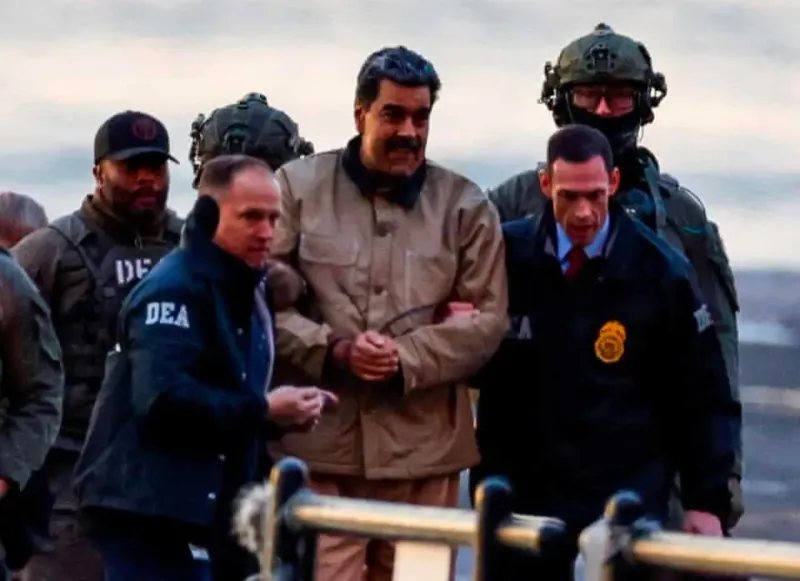



Venezuelan President Nicolás Maduro appeared in a federal court in New York City on Monday following his capture by U.S. forces in Caracas. Maduro, accompanied by his wife Cilia Flores, faces multiple serious charges including narco-terrorism, cocaine trafficking conspiracy, and weapons-related offenses, according to the U.S. Department of Justice. The appearance marks a historic first, as no sitting Venezuelan president has ever been brought to the United States to face trial.
The charges allege that Maduro and his inner circle were involved in drug trafficking operations spanning several countries, potentially carrying decades-long prison sentences. Legal experts expect the case to be complex and protracted, with numerous pretrial motions and international legal debates ahead. Maduro has consistently denied all wrongdoing, calling the U.S. charges politically motivated.
President Donald Trump, who authorized the operation, defended the move as part of a broader counter-narcotics initiative. Trump also warned that additional strikes could occur if remaining elements of the Venezuelan government do not cooperate with U.S. law enforcement objectives. International reactions have been mixed, with some governments questioning the operation’s legality under international law, while others cautiously support targeting transnational drug networks.
In Venezuela, the Supreme Court declared a temporary absence of Maduro’s presidency, appointing Vice President Delcy Rodríguez as interim president. Rodríguez has called for “balanced and respectful” relations with the United States, signaling a potential shift in Venezuela’s diplomatic approach. Public response inside the country remains divided, with some citizens continuing to support Maduro and others seeing the transition as a chance for political and economic reform.
The court appearance has heightened global debate over sovereignty, international law, and U.S. influence in Latin America. Reports indicate that Cuban citizens were affected during the U.S. operation, intensifying diplomatic tensions in the region. Analysts are closely watching how the trial may impact drug trafficking networks, geopolitical alliances, and regional stability in the coming months.



Aldrige Kennedy
Leave a Comment
Your email address will not be published.